- Details
- Written by: James Glazier
- Category: Western European Theatre
- Hits: 19
 Â
  Â
Â
- Details
- Written by: James Glazier
- Category: Western European Theatre
- Hits: 20
Â
As agreed at the Trident Conference in Washington in 1943, the Western Allies laid plans for an invasion of Europe in 1944. Ignoring the fact that they already held a foothold in Europe, Italy, the American and British planners yielded to political pressures and selected France as the target of a cross-channel assault. ...the Germans were expecting the blow to fall across the Pas de Calais, and the Normandy beaches were correspondingly less heavily defended. The whole operation was covered by the most elaborate [scheme] of deception of the whole war. Every effort was made to persuade the Germans that the Pas de Calais was the real target. For every sortie flown west of Le Havre, two were flown north of it.
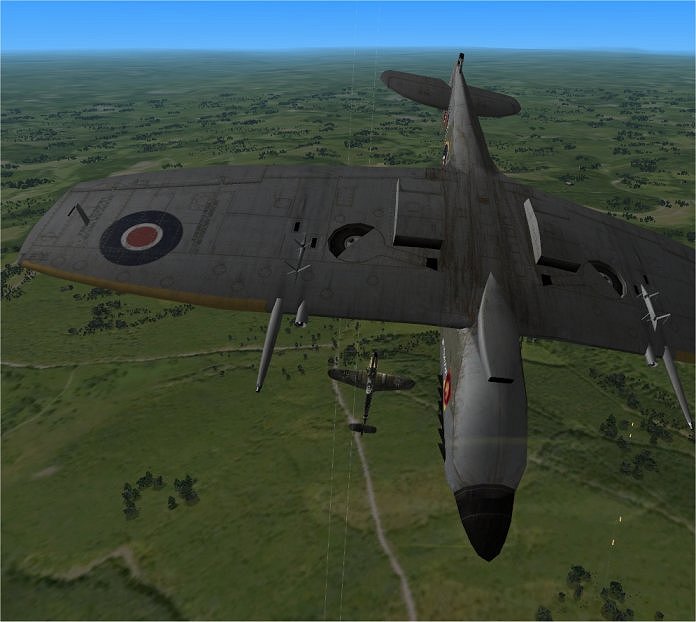
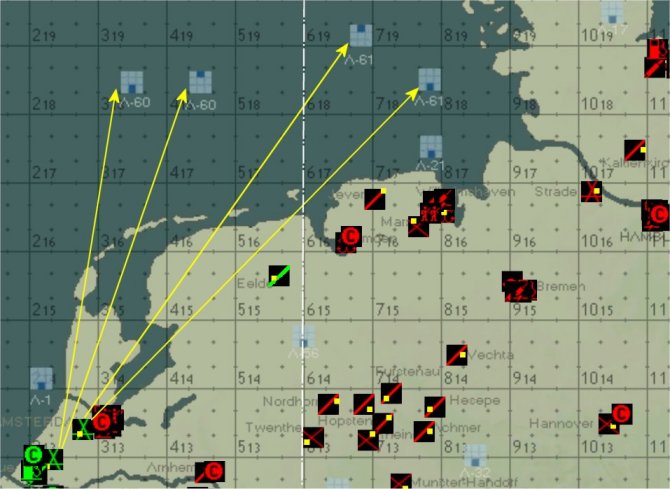
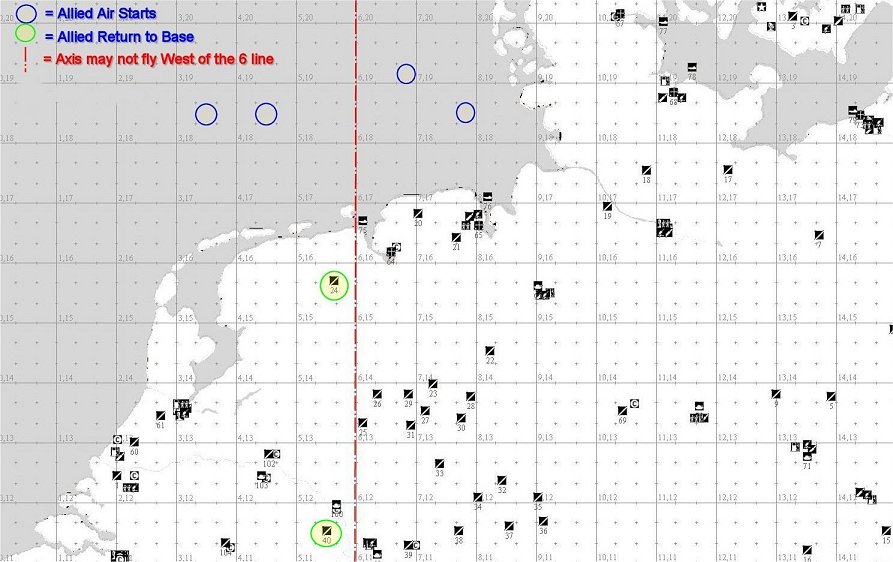
This FSO will simulate many of the sorties flown in early 1943 by the Allied and Axis forces over the channel, with each side often looking for targets of opportunity.
The Cassell – Atlas of the Second World War

"CiC's cannot assign a squad or squads to defend task groups as they are not primary targets and might not be attacked." Â
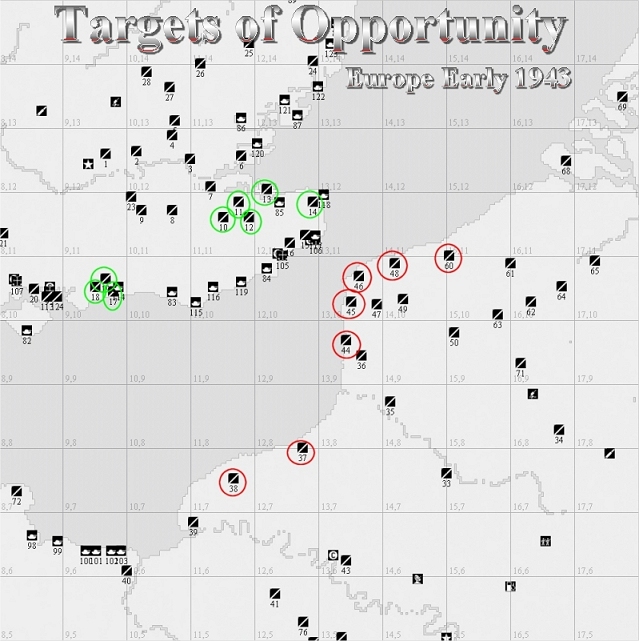
Design by: daddog
- Details
- Written by: Spikes
- Category: Western European Theatre
- Hits: 19
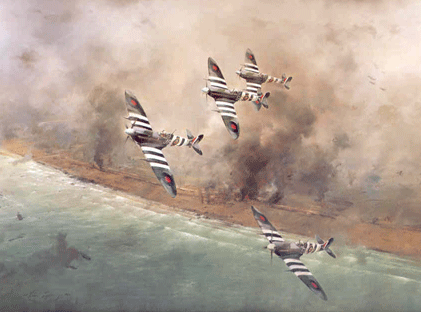
The backbone of Allied air power in the Normandy campaign centered around the mobile fighter-bomber wings of the RAF 2nd Tactical Air Force and the USAAF IX Tactical Air Force. Their mandate was to provide direct support to the American, British and Canadian armies. They had to move as the army did and be ready to change locations on short notice. When fully operational the mobile wings were completely self sufficiant organisations performing the same function as a unit in England. Airfields also had to be built from scratch or repaired, a task perfomed by engineers assigned to those airfields often using an invention called peirced steel planking (PSP) that was critical to setting up airfields quickly. Such was the importance of the tactical air force support troops that many were in the follow up waves of personnel on D+1. Within 24 hrs of the invasion the first Allied aircraft were using emergency strips on the Continent and by a month into the campaign 25 Advanced Landing Grounds (ALG) had been built.
The Luftwaffes reaction to the threatened Western Front was remarkably swift. Initially the French based JGs defending the landing area had been widely scattered to counter the threat of air attack and as a result the Jadgwaffes first efforts were woefully inadequate. However by June 9th 1944 no fewer than 15 Jagdgruppen had departed the Homeland for France. Bomber forces from Italy and southern France were also deployed to bolster the defenders bringing their combat strength to about 1000 aircraft. Now faced with having to counter both the Allied Bombing Offensive and the Normandy fighting the Luftwaffe braced itself for a fight for survival in a war few in the Wehrmacht now thought winnable. Many of the Luftwaffe units operated from rough strips during the fighting, keeping well camoflaged and disperesed untill sortied. Along with the fighters of the Jadgeschwader units many Schlachtgeschwader (ground attack) units also flew into the cauldron flying desperate missions in order to try and stem the Allied forces.
After intense fighting in the bocage country the Allies broke out during Operation Cobra in July. The following month saw the bulk of the German 7th Army retreating from the closing Falaise Pocket. August 25th saw the liberation of Paris. On August 30th the 84 day battle was over with the remaining German forces withdrawn across the Seine river. The air campaign had cost the Allies 1639 aircraft (to all causes) and the Luftwaffe 1522 aircraft (to all causes). The worst losses amongst the Luftwaffe was the high percentage of veteran aircrew killed or posted missing, valuable crews they could ill afford to lose.
This FSO recreates the defence of the Western Front by the Luftwaffes surviving experten and the Allied air forces supporting the advancing armies.
Country Percentages:
Axis 48%
Allied 52%
Field Assignments:
Axis Bishop
Allied Knight
CM Rook
OOB:
Axis (Luftwaffe):
Bf 109G-14
Bf 109G-6 (min 24)
Fw 190A-5 (min 24)
Fw 190A-8 (min 24)
Fw 190F-8 (min 24)
Recon Aircraft: Ar 234 (6 per frame, no formations) *Special mission aircraft
Allied (USAAF/RAF/RCAF):
Spitfire XVI (max 48)
Spitfire VIII (max 12)
Typhoon (max 48)
Mosquito VI
P-51B
P-47D-25 (min 24)
P-38J
A-20G
B-25C (max 24 players, formations enabled)
Recon Aircraft: F-6D (P-51D, 12 per frame) *Special mission aircraft
Special Mission (Optional): Recon missons are filmed (ALT-R) over a strike target at 4000 ft or less within light flak range and/or over the center area of the target after the strike is completed but within 60 min of frame start. They must rtb safely to get the points for the mission. Confirmation film to be emailed to the Admin CM.
Scoring:
Aircraft Pts
------------
B-25 = 20 pts
Arado 234 = 25pts
Twin Engined aircraft = 10 pts
Single Engined aircraft = 5 pts
P-51D = 20 pts
Landing Bonus = 5 pts
Ground Target Pts
-----------------
Gun = 1 pt
Ammo Bunker = 3 pts
Barracks = 3 pts
Radar = 3 pts
Vehicle Hangar = 25 pts
Fighter Hangar = 25pts
Bomber Hangar = 25 pts
Town Building = 3 pts
Factory at strategic target = 3 pts
Truck in convoy = 1 pt
Train = 2 pts
Cruiser= 100 pts
Arena Settings:
- Battle of Britain terrain
- Fuel burn 1.2
- Icons short (3k)
- 0.5 Ack
- Fighter and Bomber warning range 42,000 (about 8 miles)
- Tower range set to 42,000 (for display only to match the above setting)
- Haze/fog full visibility (17 miles)
- Radar off
- Enemy collisions on
- Friendly collisions off
- Killshooter off
- Time: 15:00 ( 3PM ) Game Clock
- Formations: On
- Bomber calibration: Manual
- Wind: 0-2K NO WIND
2K-18K W TO E - Speed 5
18K-24K NW TO SE - Speed 10
24k+ W TO E - Speed 15
Designer's Notes:
Design by Warloc
- Details
- Written by: James Glazier
- Category: Western European Theatre
- Hits: 18
Â
Â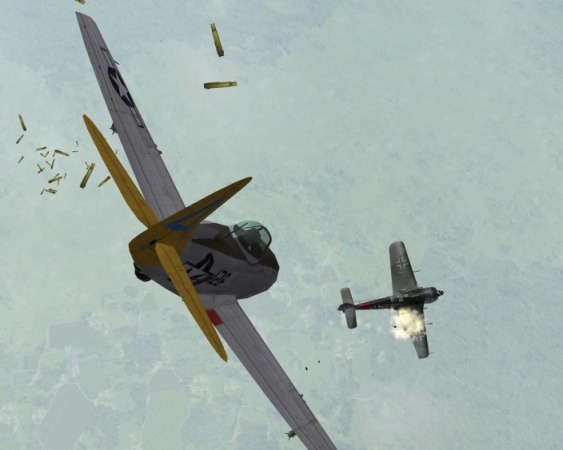
Artist Credit: Wolfola screen shot
Point Blank Range
January 1945
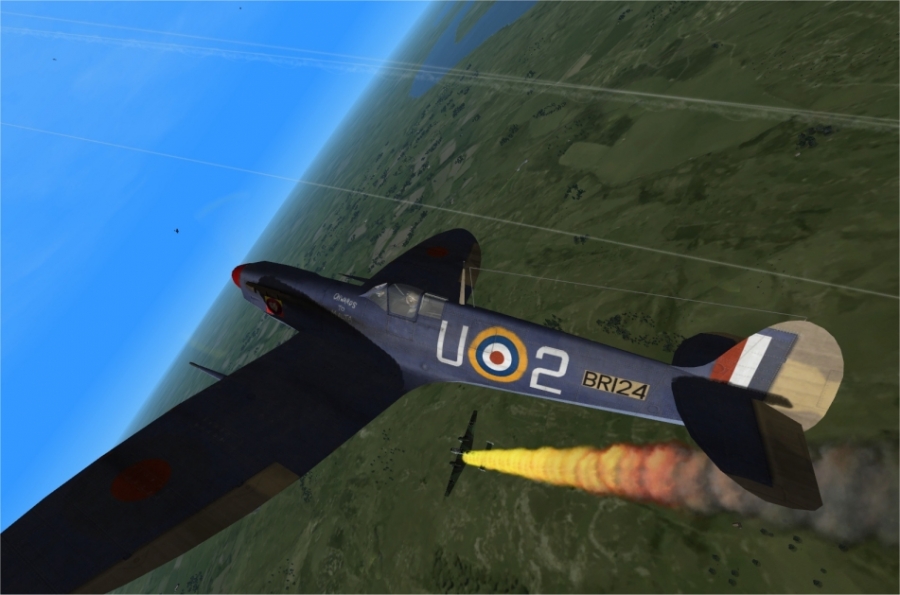
On January 14th, 1945 the 8th Air Force sent about 600 B-17's into Northwest Germany. They were well escorted by the P-51's. Chuck Yeager and Clarence Anderson rolled as spares'. It was their last mission. It turned out they were not needed and they wandered around southern France and Switzerland. Out of boredom they dropped their drop tanks on a lake and strafed them. After returning home they had missed the biggest dog fight of the war. Below are some first hand accounts of that day by various fighter and bomber groups.
Colonel Irwin Dregne wrote, "North west of Brandenburg a large formation of fighters headed towards a the lead box of bombers. They were from JG300 and included about 75 Fw190's at 28,000' and about 100 Bf-109's as top cover around 32,000'."
After a dog fight that took them to the deck Ralph Mann and Robert Foy spotted a locomotive just east of Nienburg and destroyed it. Shortly after that he and his wingman destroyed a single Fw-190 sitting on the runway of a field.
John R. Stern wrote, "As three Me 109?s crossed from my right to left I broke into them, picking out the tail end charley. I fired several bursts observing hits near the cockpit and wing roots. We made a couple turned they he began to snap and spin."
Major John B. England wrote, "I caught on Me 109 which slipped through and started toward the bombers. I got on is tail but was out of firing range. The pilot displayed a little judgment by looking around, then put his sip into a ninety degree vertical dive from about 32,000'. I followed him down. At 8,000' he made a very tight pull out and leveled off. I made a tighter pull out and started firing at 200 yards closing to 50 yards. I got strikes all over the left side of the fuselage and left wing. Just before I released the trigger, about four feet of the left wing ripped off."
Lt. Sublett reported during an engagement, "The last four 109's broke into us. We started a honey of a Lufberry which went about six turns. I finally cut the butter and got a short burst into one of them. I was going straight down when I fired from about 100 yards, seeing many strikes go right into the pilots through the top of his canopy."
Leonard Carson wrote, "The leader broke off and headed for the deck. I dropped down to tail end Charlie as he started down. He pulled up, losing speed, I kept my excessive speed, fired walled it and started firing at about 300 yards to about 20 yards, getting hits all over the fuselage. He went into a tumbling spiral and crashed."
Raymond Bank called out a Me 262 that was bouncing his flight. "The enemy aircraft overshot and made a slight turn to the left. I turned on my gun switches and pulled my nose up and fired at the Me 262. The 262 disappeared from sight." Minutes later, "I closed to about 100 feet behind [a Fw190] and set him on fire. I bounced a third 190 as he dived and came up into a loop. At the top of it he kicked it into a hammerhead and to make a perfect head-on pass. He was going fairly slow and gave me a perfect target. I fired until he burst into flames."
Â
Country Percentages:
Allies 50%
Axis 50%
Â
Plane Set:
Allied Aircraft
P-51D
P-38L
P47D40
B-17 (min 30)
B-24 (Min 30)
B-26 (Min 30)
A20
Mosquito
Spitfire XIV
Spitfire XVI
Typhoon
Tempest (Limited to 20. Frame losses will not be replaced)
Â
Active Fields:
Airstart Fields A70, A72, A73 (only B17's, B24's, and B26's may use the airstarts)
Regular Fields A48, A51, A63, A66, A75.
Â
Special Rules:
Allies must use 9 of the 12 aircraft listed. Three of those 9 must be the B17, B24, and B-26. A minimum of 15 per each type used (other than the B17, B24, B26 which have a minimum of 30 each) by the CiC.
Players may land and rearm at any friendly field.
When attacking fields the only targets are the hangers (Bomber, Fighter, Vehicle) and ack are targets.
Â
Axis Aircraft:
Bf109G14
Bf109K
Fw190D
Fw190A8
Me262 (Limited to a total of 16. Frame losses will not be replaced)
Me163 (Max of 8 per frame)
Bf110G2
Â
Active Fields:
Regular Fields A10, A20, A22, A25, A29, A39, A42, A46, A53
Â
Special Rules:
Axis must use 5 of the 7 aircraft listed. The Me262 and Me163 do count toward the 5 required aircraft. A minimum of 30 per each type used by the CiC with the exception of the Me262 and Me163.
Players may land and rearm at any friendly field.
Â
Special Conditions:
Pilots may still reup without question in the first 15 minutes, but any aircraft destroyed on take off will count in the frame score against that side.
Only a squad that volunteers should be assigned the Me163. Me163 pilots may sit on the runway and roll when ordered to by the CiC or C.O. Me163?s only have about 5 minutes of fuel at full throttle.
Â
Victory Conditions:
Single pilot fighters -10 points
Mosquito -15 points
B26Â - 20 points
B17 & B24 - 25 points
Strat targets 300 points each. (based on % destroyed)
Locomotives and cars -3 points each (targets of opportunity)
Hangers - 5 points each
Ack - 1 point each
*Points not awarded for strat destruction goes to the Axis for defending.
Â
Arena Settings:
Terrain - WinterRhine
Icon Range - ShortÂ
Radar - Off
Fighter and Bomber Warning Range - 52,800 (10 miles)
Tower Range - 52,800 (for display to match the above Fighter and Bomber Warning)
External view for bombers (F3) - On
Friendly Collisions - Off
Enemy Collisions - On
Kill Shooter - Off
Fuel - 1.0
Ack - 0.4
Time - 11:00 AM
Formations - Enabled
Bombsite calibration - Manual
Weather - Heavy Clouds, Thick Overcast
Time 2 PM X 1
Visibility - Will vary
Object Downtime - full
 Winds - Strong gusts above 21k
Â
Special Notes:
Please note that the supply trains have many bugs. Some don't follow tracks, others have the engine separate from the cars.
Â
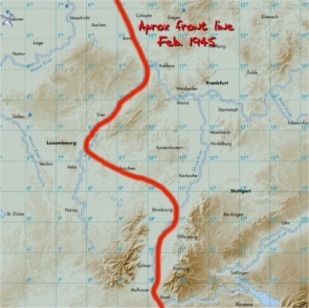
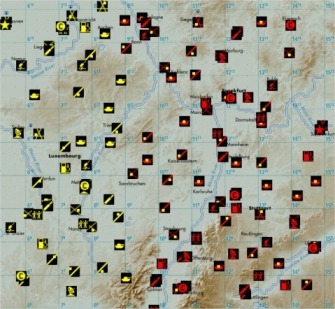
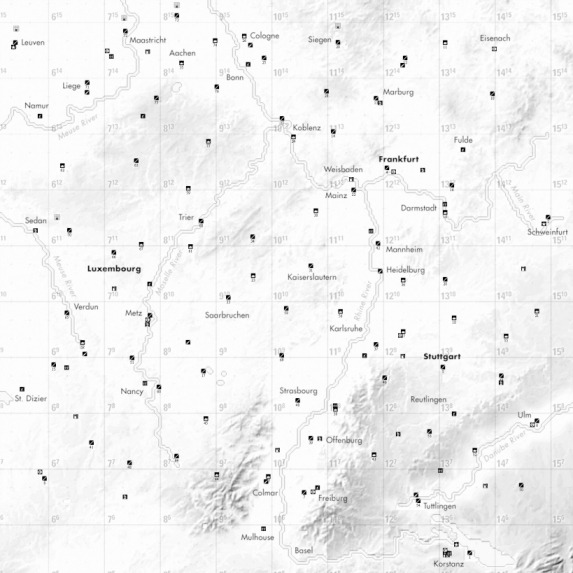
Strat maps:
Â
    Â
     Â
 Â
Â
Â
Design by: James "daddog" Glazier
- Details
- Written by: Darren F. Gideon
- Category: Western European Theatre
- Hits: 20
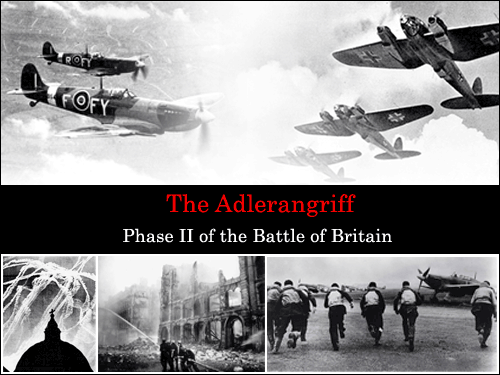
The Adlerangriff
Phase II of the Battle of Britain
DESCRIPTION
The summer of 1940 had not turned at all like the British had hoped for when they first declared war on Germany. The ?Sitzkrieg? had given way to the brutal realities of the blitzkrieg and resulted in the British being kicked off the continent. Their only silver lining was the miraculous evacuation a large portion of their troops (minus their equipment) from Dunkirk along with some French forces. However, the French surrender on June 22 1940 overshadowed this and made it seem insignificant.
Meanwhile Hitler believed that war was practically over and he expected that the British, defeated on the continent and without European allies, would quickly comes to terms and negotiate an end to the war. This attitude resulted in German forces taking a leisurely several weeks to replace their losses and to take over captured airfields in France while waiting for the British to capitulate. Meanwhile Winston Churchill, the newly installed Prime Minister of Britain, use the time to harden public opinion against coming to terms with Germany to prepare the British public for a long war and what it would take from them.
Finally Hitler and the German high command came to the realization that Britain would not yield but would have to be brought to heal and the only way to do this would be by an invasion. The Germans started planning Operation Sea Lion, the amphibious invasion of Britain, but they realized for a successful cross channel assault that they would need to neutralize the RAF and control the air over the channel.
The Luftwaffe started significant operations against Britain in July 1940. This first stage of the battle was to be known later as the Kanalkampf. The Luftwaffe?s plan was to concentrate on attacking British shipping in the Channel, attacking their Channel Ports, and attacking radar installations along the British south coast. They hoped these attacks would draw out the RAF and allow them to destroy the RAF and they estimated that the RAF would be overcome in four days.
They were wrong.
After 32 days (not four) they finally believed that the British early warning system had been destroyed and their coastal towns and installations had been sufficiently softened up for an invasion. The Luftwaffe then began the next stage of their plan, the Adlerangriff (?Eagle Attack?).
Their strategy was to now concentrate on attacking the RAF coastal airfields. By doing this they hoped to be more successful in destroying the planes of the RAF fighter command while at the same destroying their supporting infrastructure.
However, weather delayed the start of this phase of their plan until August 13th and it would last to August 23rd. The Germans would conduct both low level raids, to sneak past the battered but still working radar stations and also high level raids at the same time. The whole goal was to put pressure on the RAF and destroy their planes in the air or on the ground.
This pattern continued in September and pressure on the RAF 11 Group ground it down to a desperate state. The RAF was forced into pressing into service civilian airfields and suitably level grass fields to compensate for their badly damaged RAF stations. However, there was nothing they could do about their maintenance and spares parts supply situation which had become dangerously stretched. Ground crews working in the open suffered heavy casualties from the raids, and many maintenance facilities were destroyed in the Luftwaffe attacks. Despite this, the crews kept the fighters as combat ready as possible in an attempt to hold on as best as possible against the Luftwaffe onslaught.
The question is can the RAF and hold on?
PLANESET FOR THE FSO
RAF PLANESET
Hurricane Mk I
Spitfire Mk I
LW PLANESET
Bf 109E-4
Bf 110C-4b
Ju 87D-3
Ju 88A-4
COUNTRY PERCENTAGES
The sides will be divided into roughly 45% British and 55% German.
SCORING
SURVIVING FRAME BONUS
Any pilot who survives the whole frame and lands his plane successfully (is recorded as a land .. bails, ditches, captures, etc. don't count) will earn a survival bonus the equivalent to half the points of the plane he is flying. So a Hurricane, Spitfire, Bf 109 would earn 2.5 pts for survival.
AIRCRAFT
05 pts - Single Engine AC with 1 crew
10 pts - Single or double engine AC with 2 crew
15 pts - Double Engine AC with 3+ crew
BASES
288 - Small Airfield
396 - Medium Airfield
572 - Large Airfield
219 - Vehicle Base
SHIPS
CA - 60 points
DD - 30 points
NOTE: The German?s score points for destroying objects at their designated target (base). A list of the point value per object will be released with the objectives for each frame. The British get points for any undestroyed object at a target.
ARENA SETTINGS
- BoB04 terrain
- Fuel 1.25
- Icons short
- .5 Ack
- Radar (Bar only) : 60 mile range,10 minute update, altitude 500 ft and up
- Fighter and Bomber warning range 52,000 (about 10 miles)
- Tower range set to 52,000 (for display only to match the above setting)
- Clouds / visibility
Frame 1, 9 miles
Frame 2, 11 miles
Frame 3, 8 miles
- Radar off
- Friendly collisions off
- Enemy collisions on
- Kill shooter off
- Calm winds
- Time: 11 AM
SPECIAL RULES
NOTE: special rules sent out with the objectives trump these special rules.
1. Nobody on the British and German side gets a second life flying a plane. This includes Ju 87s.
2. Bomber formations are enabled / available.
3. A minimum and maximum number will be assigned to each aircraft type. The CiC of each side must deploy the designated minimum per aircraft type and can not more than the maximum per aircraft type. Outside of that the CiCs can deploy the aircraft types anyway the want (i.e. can have squads fly 2 aircraft types and in split they wish as long as squads are assigned same objective).
4. If both CiCs agree they may have the setup CM end the frame early by calling a cease fire and RTB publically. All players need to return to base if the CM does this. This is usually done if one side wipes out the other side (i.e. 60 versus 5). Logs will stay open until either the last player is down or T+120.
5. Dead pilots may gun bombers. They may not man the guns of airfields or ships.
6. Ships can maneuver by the allied side during the frame as long as they stay in their containment area. Ships must stay in containment area defined in the objective orders. If they go outside of the containment area a penalty will be assessed.
7. All targets must be attacked within the first hour of the event. Both CiCs should include sending their battle plans to me so that I have proof that they planned to attack their targets by T+60.
8. All attack targets assigned must be attacked by a credible force. I define a credible force to be at the very least 3 x 4-6 squads (so 12-16 planes) or 1 7x10 squad and 1 4x6 squad or 1 11x15 squad. Obviously CiCs can deploy a larger force per target as their plan dictates but no defending or attacking with just 1 x 4-6 squad.
9. All defense targets must be defended by a credible force. I define a credible force to be at the very least I define a credible force to be at the very least 3 x 4-6 squads (so 12-16 planes) or 1 7x10 squad and 1 4x6 squad or 1 11x15 squad.Obviously CiCs can deploy a larger force per target as their plan dictates but no defending or attacking with forces less than the minimum credible force denoted here.
10. Radar is going to be used on the British side since it was a key part of the battle. The radar is bar dar not dot dar. It also has a 10 minute refresh rate to simulate the lag that it took for the radar operators to report information to command and control and then for command and control to relay that to the fighters in the air.