- Details
- Written by: Spikes
- Category: Western European Theatre
- Hits: 16
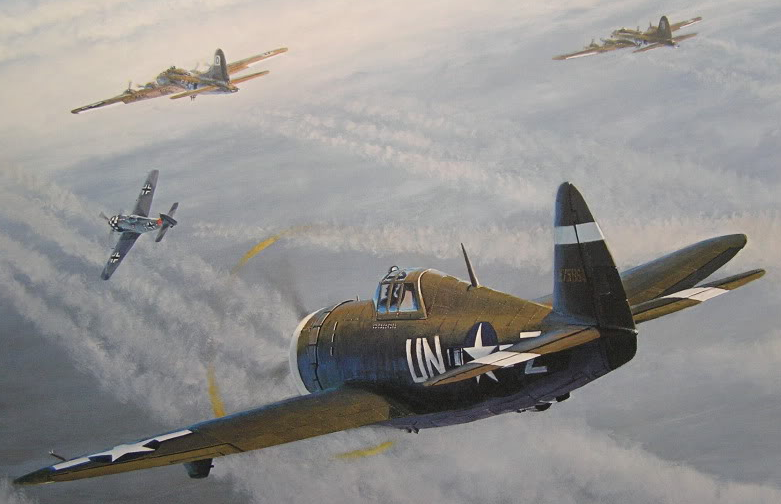
This setup is focused on the Fall 1943/Early Winter 1944.
The P51 Mustang is yet to make it's impact on the Air War. P-47D Thunderbolts from the 4th 56th 78th 352nd 355th Fighter Groups and P-38J Lightnings from the 20th and 55th Fighter Groups using drop tanks do their best to protect 8th AF Bombers from the Luftwaffe. The German Jagdgeschwaders based on the Channel JG-2 JG-3 JG-26 and JG-27. Along with the defenders of the Dutch and German North Sea coastlines JG-1 and JG-11. Are all forced to deal with the new threat of long range escorts when intercepting the American B-17s and B-24s.
Side Split 50/50
Allied= Bishops.
Aircraft:
B-17 Min of 30 Formations--- 500 lb bombs only
B-24 Min of 30 Formations ---500 lb bombs only
P-47D11 External Ord--- Drop Tank Only
P-38J Min External Ord--- 1 Drop Tank Only
Active Bases: All Bases West of 6 line available for takeoff rearm and ending flight.
Air Starts from designated bases and directions identified on objective map.
Axis= Knights
Aircraft:
BF-109G2
BF-110G2 Min of 25 **All BF-110s must attempt attack with WGr21 Rockets if at all possible**
FW-190A5 Max 40

- Details
- Written by: Spikes
- Category: Western European Theatre
- Hits: 21
October 31st, 1941
The infamous U-boot Ace Erich Topp sat
perched in the conning tower of U-552 looking through his attack
periscope. Convoy HX-156 was steaming East, South of Iceland preparing
to rendezvous with British Escorts. The command room was silent as the
weapons officer whispered up to the bridge. The firing solution that was
entered would change the course of history.
Â
At
8:34PM, U-552 released a salvo of two torpedoes and struck the USS
Reuben James in the Powder Stores, blowing the Bow off the front of the
Clemson Class Destroyer. The forward part of the ship sank immediately
with all hands while the stern some how managed to stay afloat.
Unsecured depth charges would kill some of the survivors as the stern
slipped below the waves 5 minutes later.
In all, 46 men were
rescued from the the Reuben James with one survivor dieing days later.
115 crewmen were dead and a sickened nation wanted answers, more over,
revenge.
November 3rd, 1941
Roosevelt
meets with his cabinet and the Joint Chiefs in the Oval Office. Public
outcry pressures the United States to act as this wasn't the first
American Vessel to be sunk by German U-boats, but the President remains
hesitant. Â He agrees that the Axis must be stopped, but insists the US
is not quite ready for what is already seen as a possible three front
war. It was agreed that some kind of retribution in the form of sneak
attack was needed to bring the US into the war against Germany and most
likely the rest of the Axis powers.
Numerous top-secret plans
came across his desk, but he decided to go with Operation: Erinyes;
Commander-In-Chief Atlantic Fleet Admiral Kings idea of a surprise
attack on German capital ships currently under repair at Brest, France.
The USS Hornet, Ranger, Wasp & Yorktown were all in the Atlantic and
began steaming for Norfolk, Virginia per orders of Atlantic fleet. They
took turns replenishing Diesel, Aviation Fuel and other provisions and
by November 12th Task Force Fury was under way led by Rear Admiral A. B.
Cook.
November 21st, 1941
900
miles North-Northeast of the Azores, a flight of VF-5 Wildcats from
Yorktown shot down an Fw200 Condor maritime recon aircraft. Several of
the crew managed to bailout and were rescued a few hours later by U-106
which was on patrol nearby. U-106 then radioed OKM (Oberkommando der
Marine) and all U-boats in the general area started searching for the
American Task Force. Two days later U-106 commanded by Oblt. Hermann
Rasch picked up Task Force Fury on sonar and set an intercept course but
was only able to view the escort ships and one Carrier in his periscope
far off on the horizon as they steamed past him at over 25 knots.
November 23rd, 1941
Grand
Admiral Erich Raeder contacted Hitler with grave concern about the
American Task Force that appeared to be steaming for the Bay of Biscay.
Hitler then directly ordered Vice Admiral Otto Ciliax to make as much of
the necessary repairs to the Prinz Eugen, Scharnhorst & Gneisenau
and have them sail through the heavily defended English Channel to
Wilhelmshaven. Ciliax had no choice but follow Hitlers command and on
the night of the 26th they left Brest for Wilhelmshaven.
The
following morning, the morning RAF recon flight was shocked to see the
heavy German Cruisers gone. The RAF scrambled and the Channel Dash was
on. The RAF and Fleet Air Arm tried to sink the Cruisers on several
different missions but failed to even damage the German ships. Upon
learning this from the British, Task Force Fury immediately turned north
and proceeded with the alternate mission plan. The new objective was to
engage the German ships at Wilhelmshaven, Germany. This was much more
dangerous as Task Force Fury would have to infiltrate the North Sea and
get within close enough range to launch and recover the attack groups
all while defending the Task Force from U-boats and air attack from the
Luftwaffe in Norway, Denmark and Germany.
November 28th, 1941
The
German Channel Dash was successful as the ships rounded Heligoland
Blight and now were just hours away from Wilhelmshaven. Unfortunately
things kept getting worse for Task Force Fury; the unpredictable weather
of the North Atlantic forced all aircraft to be secured. The threat of
attacks from U-boats were slim due to the weather but several U-boats
reported high speed sonar contacts and were able to relay them to OKM.
Raeder was afraid to identify them as the US Carriers, as they could
have just easily just been Royal Navy warships on routine patrol. Just
after sunset, the German ships steamed into Wilhelmshaven and were
ordered to anchor.
December 3rd, 1941
Task Force
Fury was still running headlong into blinding rain and huge swells, but
passed between the Orkneys and Scotland with relative ease. As dawn
broke, the weather began to clear in Southern England and the RAF was
tasked with a daylight high altitude photo flight of Wilhelmshaven. The
Allies were surprised to see that all three cruisers were anchored in
various locations of Jade Bay.
It
was decided that day that the RAF bomber command would try to strike
Wilhelmshaven that night to try and damage or even sink the German
cruisers. Wellington and Halifax bombers launched that evening and even
though they suffered no losses, their bombs missed there targets and
fell all around the harbor and dock works. At 2:30AM Ciliax phoned
Raeder minutes after the attack and Raeder ordered them to prepare to
depart. Raeder waited until 7:00AM to phone Hitler, but he could not be
reached. With the current situation near Moscow turning sour, Hitler was
not to be disturbed. A perturbed Hitler finally phoned Raeder later
near Noon on December 4th, but refused to grant Raeder permission to
move his battle cruisers. Raeder phoned Ciliax back and ordered him to
stay ready to depart at a moments notice but they were to stay at
Wilhelmshaven until further notice.
December 6th, 1941
As
the sunset over the Jadebusen on the evening of the 5th, Ciliax sat and sipped his coffee on the
bridge of KMS Scharnhorst. He was determined to stay up as late as he
could to anticipate another attack by the RAF, shortly after 3AM on
December 6th he retired to his quarters. With impeccable timing, he was
awoken by the flak guns from Wilhelmshaven shortly after 4AM.
This
time the German cruisers were not so lucky. Bombs from a No. 76
Squadron Halifax straddled the Scharnhorst and she was severely damaged
below the waterline. Raeder this time phoned Hitler and after a brief
but tense conversation he convinced Hitler to move his ships to Norway.
Raeder then reached Ciliax and within a few hours the ships were bound
for Trondhiem, Norway. But as they got underway, Ciliax realized that
the Scharnhorst could not keep up with Prinz Eugen and Gneisenau. It was
then decided that Tirpitz, sailing from the Baltic would meet up with the damaged Scharnhorst and proceed to Bergen, Norway.
250
miles away Task Force Fury was steaming at 25 knots South-Southeast
towards Wilhelmshaven. The sun was rising and the sea was calm enough to
resume air operations. Later that afternoon at 3PM VS-71 TBD-1
Devastators from Hornet spotted and sank U-84 commanded by Oblt. Horst
Uphoff but not before he radioed OKM that they were attacked by American
aircraft. Later that evening Rear Admiral A. B. Cook of USS Ranger was
notified that RAF Photo Recon aircraft failed to find the German ships
at Wilhelmshaven.
Â
December 7th, 1941
Right
before dawn all the American Carriers were arming attack aircraft and
launching carrier defense groups. Luftwaffe squadrons based in Germany,
Norway and Denmark were also preparing to provide escort to defend the
Heavy Cruisers, but also to find the American Carriers and sink them
before they could find the German capital ships.
After hours of
searching with RAF and FAA bombers and USN and USMC carrier aircraft,
they returned to their stations and the next group was launched. As the
day progressed an eerily calm overcast began to build. Task force Fury
was determined to launch one more group before evening.
Â
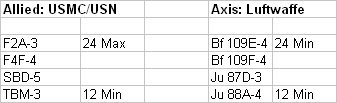
- Requirements Indicate # of Pilots.
- Formations are enabled but not required.
- Certain Aircraft will only be enabled from certain fields. Please refer to the Objectives and Orders.
- Pilots may refuel and rearm at any friendly field.
- All Aircraft must land at ACTIVE FRIENDLY FIELDS and must be down by T+120 or you will be counted as lost.
Â
Scoring:
AIRCRAFT
02 pts - Single Engine Aircraft
05 pts - Twin Engine Aircraft
SHIPS
Â
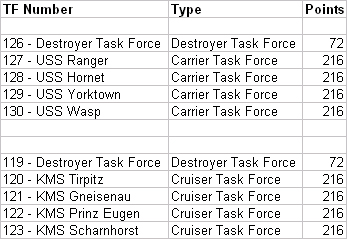
Carrier Task Force (1xCV, 4xDD)
Cruiser Task Force (1xCA, 4xDD)
NOTE: When a target is attacked the attacker gets the points for objects destroyed at the target while the defender gets the points for all objects not destroyed at the base.
- North Sea terrain
- Icon Range – Friendly 3k, Enemy 3k.
- No Radar
- Fighter and Bomber Warning Range - 63360 (12 miles)
- Tower Range – 63360 (for display to match the above Fighter and Bomber Warning)
- External view for bombers (F3) - On
- Friendly Collisions - Off
- Enemy Collisions - On
- Kill Shooter - Off
- Fuel - 1.0
- Ack - 0.4
- Formations - Enabled
- Bombsite calibration - Main Arena Standard
- Arena Time: 16:15 PM
- Visibility - 17 miles
- Object Downtime – full (200)
- Winds - None
- Details
- Written by: Spikes
- Category: Western European Theatre
- Hits: 19
version 1.2
Allied 52.5%
Axis Knight
CM Rook
Bf-109G-14 (min 20)
FW-190A-5Â (min 20)
FW-190A-8Â (min 20)
FW-190F-8Â (min 20)
-------------
Spitfire VÂ Â Â Â Â Â Â Â Â Â (min 10)
Spitfire VIIIÂ Â Â Â Â Â Â (min 10 - max 20)
Spitfire XVIÂ Â Â Â Â Â Â (min 10 - max 20)
Typhoon I        (min 10 - max 20)
Mosquito VIÂ Â Â Â Â Â Â (min 10 - max 20)
---------
P-51BÂ Â Â Â Â Â Â Â Â Â Â Â Â Â Â Â Â Â Â Â Â Â (min 10)
P-47D-25Â Â Â Â Â Â Â Â Â Â Â Â Â Â Â Â (min 10)
P-38JÂ Â Â Â Â Â Â Â Â Â Â Â Â Â Â Â Â Â Â Â Â Â (min 10 - max 20)
A-20GÂ Â Â Â Â Â Â Â Â Â Â Â Â Â Â Â Â Â Â Â Â Â (min 10 - max 20)
B-25C "Mitchell"     (min 8 - max 12) *** count of pilots, formations enabled ***
B-26B "Marauder"  (min 8 - max 12) *** count of pilots, formations enabled ***
* P-51-D, Mosquito, A-20, B-25, and B-26 aircraft must be based in England, not in France
* P-51D air-to-ground ordnance is disabled
* All variants of the B-25C are available
* All recon aircraft have an OPTIONAL mission ability to make a photo-reconnaissance run
* AR-234 RATO rockets and air-to-ground ordnance are disabled
* Bf-109G-6 and Bf-109G-14 air-to-ground ordnance is disabled
* Axis aircraft are NEVER allowed to cross the coast of England
* A pilot who survives the frame and makes a good landing at a friendly AIRBASE earns two bonus points
-----------------------------------
Arado AR-234Â Â Â Â Â Â Â Â Â Â Â Â Â Â Â Â Â Â = 10 pts
P-51DÂ Â Â Â Â Â Â Â Â Â Â Â Â Â Â Â Â Â Â Â Â Â Â Â Â Â Â Â Â Â = 10 pts
Twin-Engined Aircraft       = 3 pts
Single-Engined Aircraft     = 2 pts
-----------------------------------
Cruiser (CA)Â Â Â Â Â Â Â Â Â Â Â Â Â Â = 10 pts
Destroyer (DD)Â Â Â Â Â Â Â Â Â Â = 10 pts
Vehicle Hangar         = 10 pts
Fighter Hangar         = 10 pts
Bomber Hangar         = 10 pts
ordnance bunker        = 1 pt
field gun                     = 1 pt
troop barracks             = 1 pt
fuel storage tank         = 1 pt
-----------------------------------
01K - 08K - NW to SE - 5 MPH
08K - 16K - NW to SE - 10 MPH
16K - 24K -Â W to EÂ - 10 MPH
over 24k  - W to E - 15 MPH
- Fuel Burn Rate: 1.0
- Icons: 9000 feet (3.0K yards)
- Ack Strength: 0.60
- Fighter and Bomber Warning Range: 79,200 feet (15 miles)
- Tower Range:Â 79,200 feet (for display only, to match the above setting)
- Haze/fog Visability: 15 miles
- Radar: map sector "Bar-Dar" only, two minute delay
- Enemy collisions: ON
- Friendly collisions: OFF
- Killshooter: OFF
- Time: 11:00 AM (game clock)
- Formations: ON
- Bomb Sight Calibration: MANUAL
A104 (7,0,3)
plus the following bases in France:
V99Â (8,6,6)
V100 (9,6,4)
V101 (9,6,5)
V102 (9,6,6)
V103 (9,6,6)
A40Â (9,6,3)
A72Â (8,7,1)
A73Â (7,7,2)
C97Â (8,8,?)Â must remain in map sector 8,8
A40Â (9,6,3)
A73Â (7,7,2)
  Â
Axis assets to defend against Allied attack are:
A38Â (11,7,6)
A41Â (12,5,7)
A74Â (6,3,9)
- Details
- Written by: K Cook
- Category: Western European Theatre
- Hits: 20
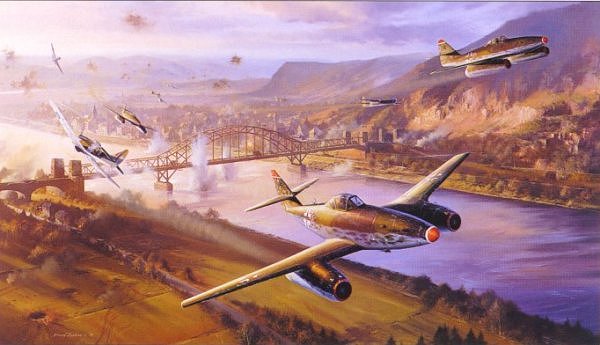
March 1945 (v1.0)
Â
After over five and a half years of war the Allies have closed in on the borders of the Reich. The Rhine River has been the barrier to invading armies entering Germany from the west for centuries, long before Germany itself existed.
Â
Source of weird and romantic legends, the Rhine River has long held a peculiar fascination for the German people, a historic moat guarding them against the traditional enemies to the west. As the German armies in the summer of 1944 fell back from defeat in France, their commanders appealed for authority to withdraw behind that moat, the only hope, they believed, for stopping the Allied armies and recovering from the debacle in France. Yet Hitler said no and continued to say no all through the fall and winter, so that with the coming of spring the military force that might have hoped to defend successfully at the Rhine had ceased to exist, destroyed in the fighting west of the river.
Â
Since the second week of January, when the complete elimination of the enemy salient in the Ardennes had become merely a question of time, General Eisenhower and his subordinates had been making plans for the resumption of offensive ground action. The strategy agreed in all essentials with the campaign plans of early December 1944. Projected operations fell into three general phases. During the first phase, while Bradley's U.S. First and Third Armies continued their systematic pursuit of the enemy in the Ardennes area and General Devers' U.S. Seventh Army and French First Army ellirninated German resistance west of the Rhine on the Alsace-Lorraine front, Field Marshal Montgomery was to launch the major offensive toward the Rhine north of Düsseldorf. The immediate aim in all areas was to achieve a maximum destruction of the German forces west of the Rhine. Once the Allied armies had reached the Rhine, the establishment of strong bridgeheads across that river would be the next task. The last phase of operations envisaged powerful drives into the heart of Germany, the destruction of all her remaining forces, and finally a junction with the advancing Russians.
AIRCRAFT
Â
Axis: 50%
Â
Ar-234Â Â Â Â Â Â Â Â Â Â Â Max 12 pilots w/formations
Bf-109G14Â Â Â Â
Bf-109K4Â Â Â Â Â Â Max 40
Fw-190A8Â Â Â Â Â
Fw-190D9Â Â Â Â Max 50
Me-262Â Â Â Â Â Â Â Â Â Â Max 16
TA-152HÂ Â Â Â Â Â Â Max 24
Â
- A minimum of 12 of each aircraft utilized must be flown each frame.
- All 7 of the aircraft must be used each frame.
                      Â
Allies: 50%
Â
P-38LÂ Â Â Â Â Â Â Â Â Â Â Â Â Â Â Â Â Â Â Â Â Â Â Â
P-47D25Â Â Â Â Â Â Â Â Â Â Â Â Â Â Â Â Â Â Â
P-47D40Â Â Â Â Â Â Â Â Â Â Â Â Â Â Â Â Â Â Â Max 24
P-51DÂ Â Â Â Â Â Â Â Â Â Â Â Â Â Â Â Â Â Â Â Â Â Â Â Max 36
B-26BÂ Â Â Â Â Â Â Â Â Â Â Â Â Â Â Â Â Â Â Â Â Â Â Â Max 20 pilots w/formations
Mosquito Mk VIÂ Â Â Â Â Â Â Â
Mosquito Mk XVIÂ Â Â Â Â Max 12 pilots w/formations
Spitfire Mk XIVÂ Â Â Â Â Â Â Â Â Max 24
Spitfire Mk XVIÂ Â Â Â Â Â Â Â Â Max 24
Tempest Mk VÂ Â Â Â Â Â Â Â Â Â Max 36
Typhoon Mk IBÂ Â Â Â Â Â Â Â
Â
- A minimum of 12 of each aircraft utilized must be flown each frame.
- At least 8 of the 11 aircraft must be used each frame.
Â
RULES
1.        A minimum of 20 players must be assigned to defend each target assigned to the enemy.
2.        All targets must be attacked within the first 60 minutes of the event.
3.        All targets must be assigned to be attacked by no less than 20 players assigned for strike, sweep and/or escort.
4.        This is a one life event in aircraft. (See vehicles for further options)
4.        Bomber formations are enabled.
5.        Players may not man guns at airfields or on ships.
7.        Players who have lost their aircraft may join as gunners to any bomber.
8.        Aircraft at no time may attack ground vehicles.
9.        Air spawns are disabled.
10.      When attacking the largest cities, the center island is the target.
Â
SCORING
Fighter  Aircraft - 1 Points
Twin Engine Bombers - 5 Points
Jet Aircraft – 5 Points
Hangars - 5 Points
Factory Building – 1 Points
City Building – 1 Points
Fuel Bunker – 2 Points
Troop Barracks – 2 Points
Ammo Bunker – 5 Points
Radar Tower – 10 Points
VEHICLES
Â
Axis
Â
Tiger Mk VI Ausf A
Panther Mk V Ausf GÂ Â Â Â Â Â Â Â Â
Panzer Mk IV
Sdk251
Â
Allies
Â
Sherman M4A3 (75)
Sherman M4A3 (76)
Sherman Firefly
M3 Halftrack
Â
RULES
1.        Ground battles will start at T+60 and last the remainder of the frame.
2.        Objective is to capture and hold center of city in frames 1 and 3 and village at field in frame 2. Note this does NOT involve troops but capture by possession and holding the ground.
3.        Players may use as many tanks as they want. If too many of the Fireflies, Panthers or Tigers are being used, the CMs will disable those for a time.
4.        Half-tracks may drop supplies.
Â
SCORING
- Details
- Written by: Spikes
- Category: Western European Theatre
- Hits: 22
Â
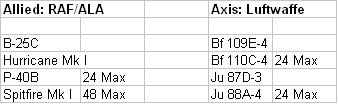
-Requirements Indicate # of Aircraft.
-Formations are enabled but not required.
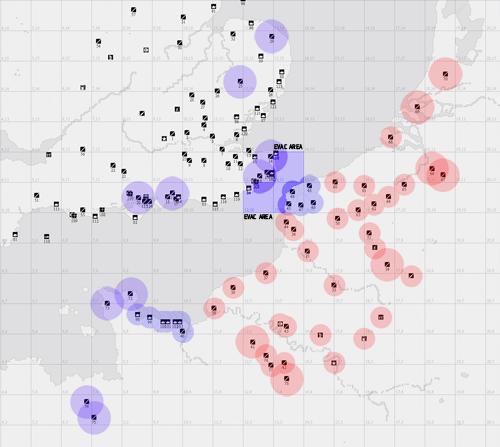
-Certain Aircraft will only be enabled from certain fields. Please refer to the Objectives and Orders.
Scoring:
AIRCRAFT
05 pts - Single or double engine AC with 2 crew
10 pts - Double Engine AC with 3+ crew
BASES
396 - Medium Airfield
572 - Large Airfield
219 - Vehicle Base
- No Radar
- Tower Range – 79,200 (for display to match the above Fighter and Bomber Warning)
- External view for bombers (F3) - On
- Friendly Collisions - Off
- Enemy Collisions - On
- Kill Shooter - Off
- Fuel - 1.0
- Ack - 0.4
- Formations - Enabled
- Bombsite calibration - Main Arena Standard
- Time 11:00AM
- Visibility - 17 miles
- Object Downtime – full (200)
- Winds - None