- Details
- Written by: Darren F. Gideon
- Category: Pacific Theatre
- Hits: 18
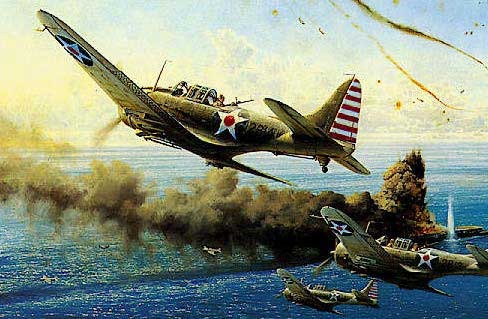
With the US Battleship fleet put out of action by the attack at Pearl Harbor these three carriers were the only heavy units left to the USN until american ship yards produced new carriers and battleships. Or until Battleships from the Atlantic fleet were redeployed to the Pacific. So it was decided to build a task force was around each carrier and have each carrier task force to start conducting hit and run raids through out the Pacific while additional forces were built up to contest the Japanese march of conquest.
On Feb. 20, 1942 the Lexington launched a raid against Rabaul on New Britian.Â
On March 10th, 1942 planes from Yorktown and Enterprise raided Lae and Salamau on New Guinea, just two days after the Japanese capture them in the face of no resistance.
On May 4th, 1942 the Yorktown launches a raid against Tulagi in the Soloman islands which turned out to be the opening to the battle of the Coral Sea.
Country Percentages
50% Allied (rough estimate)
50% Axis (rough estimate)
Plane Set
Australians
========
Boston III
P40E
USAAF
=====
P39D
P40E
USN
===
F4F-4
SBD-5
TBM-3
IJA
===
JU88 (Sub for Betty)
IJN
===
A6M2
B5N2
D3A1
Restrictions
- Boston IIIs can fly in formation
- TBMs can only use torpedoes
- JU88s can fly in formation and can use bombs or torpedoes
- B5N2s get a second life
Further restrictions will be delinated in the objective orders for each frame.
Victory Conditions
AIR TO AIR
========
5 pts - Single or dual Engine AC with 1 crew
10 pts - Single or double engine AC with 2 crew
15 pts - Double Engine AC with 3+ crew
20 pts - large quad engine AC with 3+ crew
GROUND TARGETS
=============
0.124 = Gun
0.124 = Mannable Gun
6.250 = Ammo Bunker
6.250 = Fuel Bunker
6.250 = Barracks
6.250 = Radar
55.624 = Vehicle Hangar
55.624 = Fighter Hangar
55.624 = Bomber Hangar
6.250 = Town Building
6.250 = Factory at strategic target
1.562 = Truck in convoy
3.124 = Train
40 = Destroyer
80 = Cruiser
160 = Carrier
Arena Settings
- Coral Sea terrain
- Fuel 1.00
- Icons short
- .4 Ack
- Fighter and Bomber warning range 52,000 (about 10 miles)
- Tower range set to 52,000 (for display only to match the above setting)
- Clouds / visibility
Frame 1, 8 miles
Frame 2, 12 miles
Frame 3, 9 miles
- Radar off
- Friendly collisions off
- Enemy collisions on
- Kill shooter off
- Calm winds below 26K ft.
- Time: 11 AM
- Details
- Written by: Spikes
- Category: Pacific Theatre
- Hits: 17
                  Â
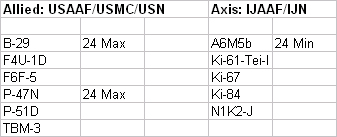
Only Aircraft with Minimums must be flown.
AIRCRAFT
02 pts - Single Engine Aircraft
BASES
Carrier  - 144
246 - Medium Airfield
374 - Large Airfield
136 - Vehicle Base
- Japan terrain
- Icon Range – Friendly 3k, Enemy 3k.
- No Radar
- Fighter and Bomber Warning Range - 126720 (24 miles)
- Tower Range –Â 126720 (for display to match the above Fighter and Bomber Warning)
- External view for bombers (F3) - On
- Friendly Collisions - Off
- Enemy Collisions - On
- Kill Shooter - Off
- Fuel - 1.0
- Ack - 0.4
- Formations - Enabled
- Time 11:00AM
- Visibility - 17 miles
- Object Downtime – full (200)
- Winds - None
Â
Designed by Nefarious
Â
- Details
- Written by: Darren F. Gideon
- Category: Pacific Theatre
- Hits: 19
Â
Â
DESCRIPTION
This FSO will recreate the invasion of Burma in 1942. Hong Kong, Malaya, Singapore, and the Dutch East Indies have already fallen but the Americans in the Phillipines are still holding out versus the Japanese. While the Japanese now have set their sites on Burma.
There were two reasons for the Japanese invasion of Burma. Firstly the Japanese knew it would serve them well if they cut overland access to China from Burma via the famed Burma Road. Along this road a steady stream of military aid was being transported from Rangoon, over the mountains of the 'Hump' and into Nationalist China, but if this supply route was closed, the Japanese could deprive Chiang Kai Shek's Kuomintang (Nationalist Chinese) armies of their life-blood, permitting the Japanese to conquer all China.
'The troops were raw, lacked combat experience, and were inadequately trained ...'
Furthermore, possession of Burma would place the Japanese at the gate of India, where they believed general insurrection against the British Raj would be ignited once their troops had established themselves in Assam, within reach of Calcutta. To this end they cultivated the services of the dissident Bengali politician Chandra Bose, who recruited thousands of Indian troops captured in Singapore into his Indian National Army - to fight the British.
Only 1 squadron of the Flying Tigers, some obsolete Buffalo Brewster fighters, Blenheim bombers and Hurricane MKIIBs rushed to the Burma are in place to try to slow the Japanese tide of conquest.
Entering Burma from Thailand, the Japanese quickly captured Rangoon, cutting off the Burma Road at source, and depriving the Chinese of their only convenient supply base and port of entry. In response, General Sir Archibald Wavell, in supreme command of the Far Eastern theatre, formed two scratch divisions, the 1st Burma and 17th Indian, into Burma corps (Burcorps).
He ordered his commanders, against their better judgement, to defend well forward. They, however, were aware, as he was not, of the deficiencies of their commands. The troops were raw, lacked combat experience, and were inadequately trained and equipped to take on the aggressive and bold invaders.
Apart from two experienced light tank regiments and an infantry battalion brought in from the Middle East, whose presence in the long retreat up-country undoubtedly saved Burma Corps from total destruction, no other reinforcements reached Burma Command. (The British 18th Division, destined for Burma, was redirected to Singapore on Churchill's orders, reaching it just in time to march into Japanese prison camps.)
Operating a scorched-earth policy as it went, Burcorps, now under command of Lieutenant General William Slim, fell back up the Irrawaddy river, accompanied by tens of thousands of wretched Indian refugees, harassed and murdered by the Burmese population as they struggled to gain Indian soil. In May 1942 the retreat finally ended, and the shattered remnants of Burcorps began to prepare for return to Burma.
COUNTRY PERCENTAGES
Roughly 50 / 50 with the IJAAF having slightly more.
SCORING
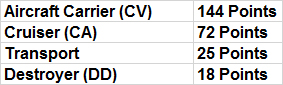
CV - 200 points
CA - 100 points
DD - 50 points
5 pts - Single Engine AC with 1 crew
10 pts - Single or double engine AC with 2 crew
15 pts - Double Engine AC with 3+ crew
TBD - Small Airfield
TBD - Medium Airfield
TBD - Large Airfield
TBD - Port
TBD - Vehicle Base
TBD - Grunt Facility
TBD - HQ
ARENA SETTINGS
- Burma terrain
- Fuel 1.5
- Icons short
- .4 Ack
- Fighter and Bomber warning range 52,000 (about 10 miles)
- Tower range set to 52,000 (for display only to match the above setting)
- Clouds / visibility
Frame 1, 9 miles
Frame 2, 17 miles
Frame 3, 11 miles
- Radar off
- Formations off - Friendly collisions off
- Kill shooter off
- Calm winds
- Time: 11 AM
SPECIAL RULES
- Only 15 P40Bs are allowed per frame
- B5N2 pilots get a second life in an aircraft assigned to them by their CiC (it can be any of the available Japanese plane types).
- No bomber formations
- No torpedoes may be used by TBM-3s or JU88s. B5N2s can use torpedoes.
- 50/50 rule is NOT being used.
- A minimum and maximum number will be assigned to each aircraft type. The CiC of each side must deploy the designated minimum per aircraft type and can not more than the maximum per aircraft type. Outside of that the CiCs can deploy the aircraft types anyway the want (i.e. can have squads fly 2 or more aircraft types and in split they wish).
- If both CiCs agree they may have the setup CM end the frame early. This is usually done if one side wipes out the other side (i.e. 60 versus 5).
- Dead pilots may gun bombers. They may not man the guns of airfields or ships.
- If ships are used in a frame each side can maneuver the ships as long as they stay in their containment area.
- All targets must be attacked within the first hour of the event.
SIDE COMMUNICATIONS
You can contact all the squads on your side here.
- http://ahevents.org/component/option,com_staticxt/Itemid,168/
Â
For more information on the Invasion of Burma and later campaigns in this theater (which are not covered in this FSO). Click on http://www.bbc.co.uk/history/interactive/animations/wwtwo_map_burma/index.shtml Â
Â
-Â
- Details
- Written by: Spikes
- Category: Pacific Theatre
- Hits: 19
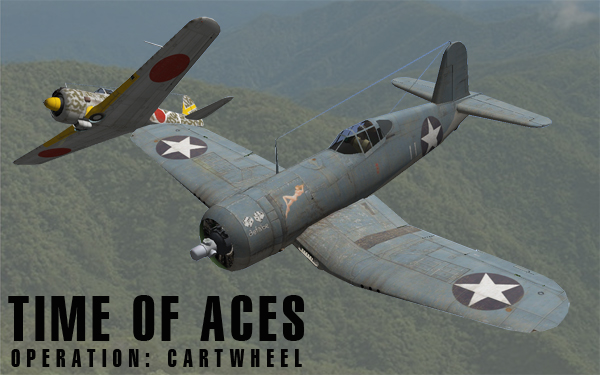
From November 1942 to February 1943 the Allies would see the introduction of several new aircraft into the theater. Aircraft like the P-38G, P-40F, and the F4U-1 were replacing the war weary F4F-4 and the P-39D. To the Northwest of Guadalcanal, The Allies were finding Rabaul a veritable hornet's nest and the Japanese would launch more long range strikes on Guadalcanal under the operation I-Go. These initial months of 1943 saw the Japanese grip on the Solomons slipping but the situation was still uncertain.
By June 1943 the Allies had launched Operation Toenails, The Landings on New Georgia and By November the Allies would land on Bougainville during Operation Cherry Blossom. Operation Cartwheel would last into 1944 and used the strategy of avoiding major concentrations of enemy while cutting Japanese communications and supply lines. Although Rabaul would remain in Japanese hands until the Japanese surrender in 1945.
This FSO is a revisit to 68KO's 2006 setup and depicts the situation in the Solomons and Rabaul beginning in February 1943.
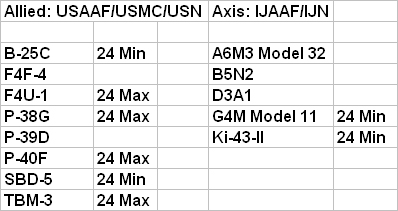
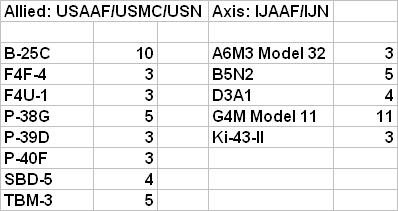
- Requirements Indicate # of Pilots.
- Formations are enabled but not required.
- Certain Aircraft will only be active from certain fields. Please refer to the Objectives and Orders.
- Pilots may refuel and rearm at ANY FRIENDLY FIELD.
- All Aircraft must land successfully at ANY FRIENDLY FIELD before T+120 or you will be counted as lost.
Â
 Â
Each side will have one mandatory Ace mission per frame. These frames will represent notable pilots of the time and theater. One pilot from each side will designated an "Ace" Pilot. They must fly the Aces listed aircraft. The Aces must be relayed to the Admin CM before launch. They will be scored as follows.
Â
Ace Pilot = 20 Points
Ace Pilot Kills = 20 Points
Â
So for example if an Ace Pilot is shot down they are worth 20 points to the other side. Like wise, every victory an Ace Pilot lands they will be rewarded 20 points.
FRAME 2 – F4U-1 – Kenneth Walsh was one of the most experienced pilots in the USMC's first Corsair squadron when they arrived at Guadalcanal in February 12th 1943 and they were thrown right into combat the day they arrived. He claimed his first three Japanese planes on April 1st and would become the first Corsair ace on May 13th. He would be awarded the Medal of Honor for his actions against the Japanese on August 30th. Walsh retired a Lt Colonel and passed away in 1998.
FRAME 3 – P-38G - Murray "Jim" Shubin, a Pittsburgh PA native, Shubin scored his first victory on February 2nd with another on June 7th. During a huge raid on Guadalcanal on June 16th he would shoot down 5 enemy Zeros and claim another probable. He would claim two more enemy aircraft bringing his total to 11 enemy before being sent back to the states. He was awarded the Silver Star and the DFC. Shubin was killed in a vehicle accident in France in 1956. Â
AXIS ACES
FRAME 1 – A6M3 Model 32 – Kenji Yanagiya was sent to Rabaul in October of 1942 with the 204th AG and recorded his first victory on January 5th 1943. On April 18th he took part in the ill-fated escort mission of Yamamoto. Yanangiya continued flying and while on a mission to the Guadalcanal was seriously injured by F4Fs. With his right hand nearly shot off, he flew all the way back to Munda on New Georgia Island fighting blacking out from loss of blood. Yanangiya was credited with at least 8 victories and passed away in 2008.
FRAME 2 – A6M3 Model 32 – Masaaki Shimakawa claimed his first victory on the opening day of the war against the US in the Philippines. A pilot in the famed Tainan Air group of Rabaul he was aboard the Carrier Kaga when it was sunk during the Battle of Midway. He was rescued and then began flying in the Solomons where he would down a total of 8 aircraft and share in another 12-13 before coming down with Malaria and being shipped home in March 1943. Shimakawa passed away in 1997.
FRAME 3 – A6M3 Model 32 – Ryoji Ohara was sent to Buin in October of 1942 and immediatley began claiming victories, his first on October 23rd. His fellow pilots dubbed him the killer of Rabaul and was credited with shooting down the F4U-1 of VMF-124 CO, William Gise on 13 May 1943. Ohara was later transferred back to Japan where he would serve until the end of the war with the Yokosuka AG. Ohara would claim 48 kills and would later serve in the JSDAF.
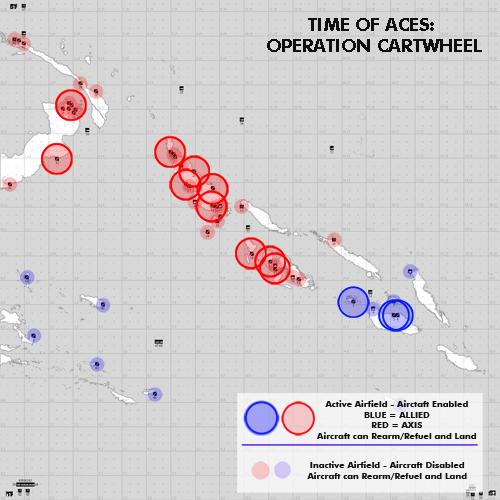
- Solomons Terrain
- No Radar
- Fighter and Bomber Warning Range - 63360 (12 miles)
- Tower Range – 63,360 (for display to match the above Fighter and Bomber Warning)
- External view for bombers (F3) - On
- Friendly Collisions - Off
- Enemy Collisions - On
- Kill Shooter - Off
- Fuel - 1.0
- Ack - 0.4
- Formations - Enabled
- Bombsite calibration - Main Arena Standard
- Object Downtime – full (200)
- Winds - None
- Game Clock:
           Frame 1: 06:00
           Frame 2: 12:00
           Frame 3: 16:00Â
- Details
- Written by: Spikes
- Category: Pacific Theatre
- Hits: 17
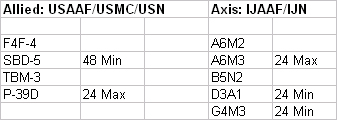
- Requirements Indicate # of Pilots.
- Formations are enabled but not required.
- Certain Aircraft will only be enabled from certain fields. Please refer to the Objectives and Orders.
- All Aircraft must land at ACTIVE FRIENDLY FIELDS and must be down by T+120 or you will be counted as lost.Â
AIRCRAFT
BASES
Carrier  - 144
396 - Medium Airfield
572 - Large Airfield
219 - Vehicle Base
Frame 2 - Warrant Officer Toshio Ota (IJN)
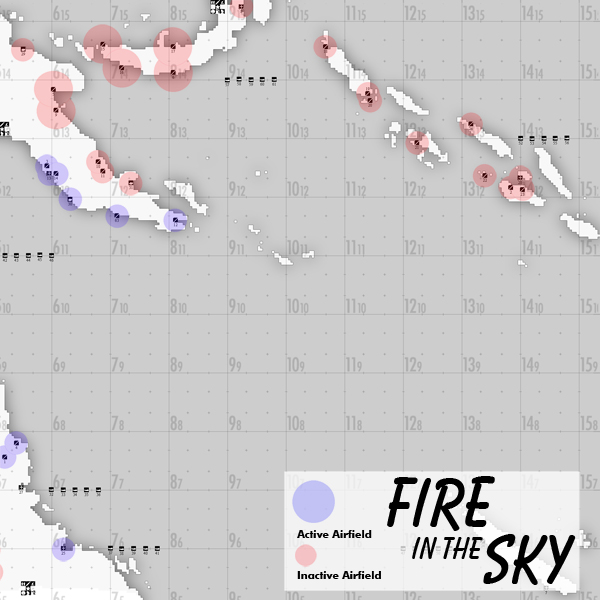
- No Radar
- Fighter and Bomber Warning Range - 63360 (12 miles)
- Tower Range – 63360 (for display to match the above Fighter and Bomber Warning)
- External view for bombers (F3) - On
- Friendly Collisions - Off
- Enemy Collisions - On
- Kill Shooter - Off
- Fuel - 1.0
- Ack - 0.7
- Formations - Enabled
- Time 11:00AM
- Visibility - 17 miles
- Object Downtime – full (200)
- Winds - None
Â