Test site The live site is still ahevents.net — sign-ups and log uploads there are the real ones. Please poke at everything here: nothing is permanent, and if it gets into a mess we can roll it back. Problems to Steely07 on the Aces High BBS.
- Details
- Written by: Will Hyman
- Category: Pacific Theatre
- Hits: 17
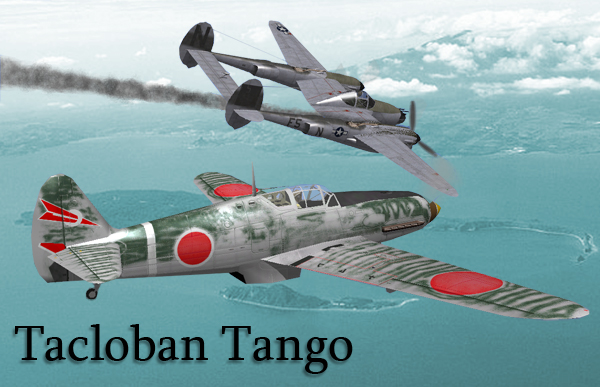
After the Solomons operations had concluded, most U.S. Marine aviation remained in and around the Solomons areas, or moved north and operated out of the captured airfields of the Nimitz's thrust through the Central Pacific. Likewise, US Army Air Force resources had been supporting MacArthur's push through New Guinea and into the Phillipines. Neither service had participated in the same scale of joint operations that had characterized the desperate days of the Cactus Air Force on Guadalcanal in late 1942. But, due to poor weather and lack of resources on Leyte, 5th Air Force was not able to move as quickly to operate out of the new fields captured during the landings in late October of 1944.
Meanwhile, off the coast of Leyte, Admiral Kincaid's 7th Fleet was being involved in an on-going air and naval battle that was increasing in intensity. Even after the failed attempt by the Japanese Navy to drive off the invasion force, during the Battle of Leyte Gulf, the Japanese continued to move ships and aircraft throughout the Leyte and Samar island areas to disrupt the allied assault on Leyte, while Kamikaze attacks increased on the ships in San Pedro Bay. Admiral Kincaid began to feel more exposed and pressed 5th Air Force and General MacArthur for more air cover. A compromise was reached, when MacArthur ordered Marine Air Group 12 to move to Tacloban, and begin operations under the command of 5th Air Force.
Ultimately, through December 1944 and January 1945, MAG-12, and eventually MAG-14 participated in the second major joint air campaign of the war as they teamed up with 5th Air Force assets to support both 7th Fleet at sea, and 6th Army on Leyte. This FSO will attempt to recreate the events of December 1944 and January 1945 in the Phillipines.
AIRCRAFT:
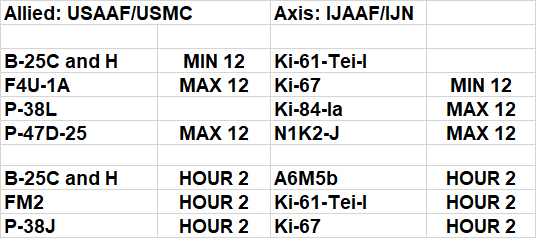
- Fighter Cap 20K - Bomber Cap 14K.
- Aircraft with MINIMUM requirements must be flown.
- ALL Fighters Bombs and Rockets Disabled.
- Formations are enabled but not required.
- Pilots may refuel and rearm at ANY FRIENDLY FIELD.
SCORING:
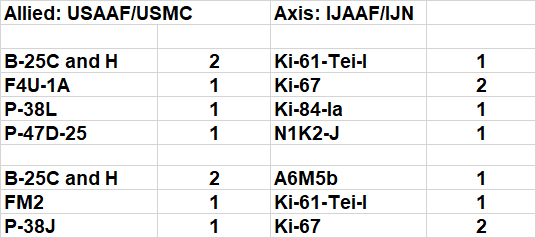
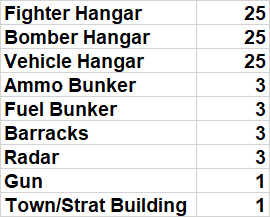
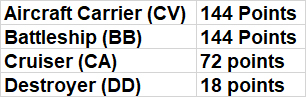
OBJECT SCORING:
HOUR 2 SCORING (SHIPS ONLY)
ACE MISSIONS:
Each side will have one mandatory Ace mission per frame. These frames will represent notable pilots of the time and theater. One pilot from each side will designated an "Ace" Pilot. They will be scored as follows.
Ace Pilot = 20 Points
Ace Pilot Kills = 5 Points
So for example if an Ace Pilot is shot down they are worth 20 points to the other side. Like wise, every victory an Ace Pilot lands they will be rewarded 5 points.
IJN/IJAAF Aces
Frame 1 - Lt Commander Ayao Shirane (IJN) A veteran of the carrier battles of Midway, the Eastern Solomons, and Santa Cruz. In July of 1944 he was given command of the 401st Sqaudron of the Yokosuka Air Group flying the new N1K Shinden (George). In October 1944 he took his squadron to Luzon where they saw immediate action. Shirane was shot down and killed by P-38s from the 433rd FS on November 24th 1944. He had 9 aerial victories.
Frame 2 - Master Seargeant Satoshi Anabuki (IJAAF) Anabuki fought in the 1941 invasion of the Philippines and then in Burma. In October 1943 he shot down three B-24s and 2 P-38 escorts. He downed one of the B-24s by ramming it, wounding himself. He would later ferry Ki-84 fighters from Formosa to the Philippines where he would shoot down 6 F6F Hellcats. He would survive the war claiming 59 victories but was officially credited with 39.
Frame 3 - Chief Petty Officer Shoichi Sugita (IJN) - Sugita saw fierce action in the Solomons and became a leading ace in the campaign and flew in the infamous Yamamoto mission. Sugita was given a chance to redeem his honor and continued to fight on in the Carolines, Marianas and scored numerous kills in the Philippines. Sugita was killed while trying to take off on 15th 1945 in the defense of Japan. He was recognized as having achieved 70 victories.
USAAF/USMC Aces
Frame 1 - Colonel Charles MacDonald (USAAF) - MacDonald arrived in Dobodura, New Guinea in October, 1943 and scored 4 victories that month. He became an ace on November 9th 1943. While commanding the 475th FG in the Philippines he shot down 13 enemy aircraft from Nov 10th 1944 to January 1st 1945. MacDonald would score his final victory March 13th1945, bringing his total score to 27. Charles MacDonald passed away in March, 2003.
Frame 2 - Major William Dinghy Dunham (USAAF) When Dunham was given command of the 460th FS of the 348th FG he had already shot down 9 enemy fighters in the New Guinea area. While in the Philippines Dunham would shoot down 1 Japanese fighter on November 18th and then shoot down 4 in one day on December 7th, 1944. In all, William Dunham would shoot down 16 aircraft during World War 2. He passed away in March, 1990.
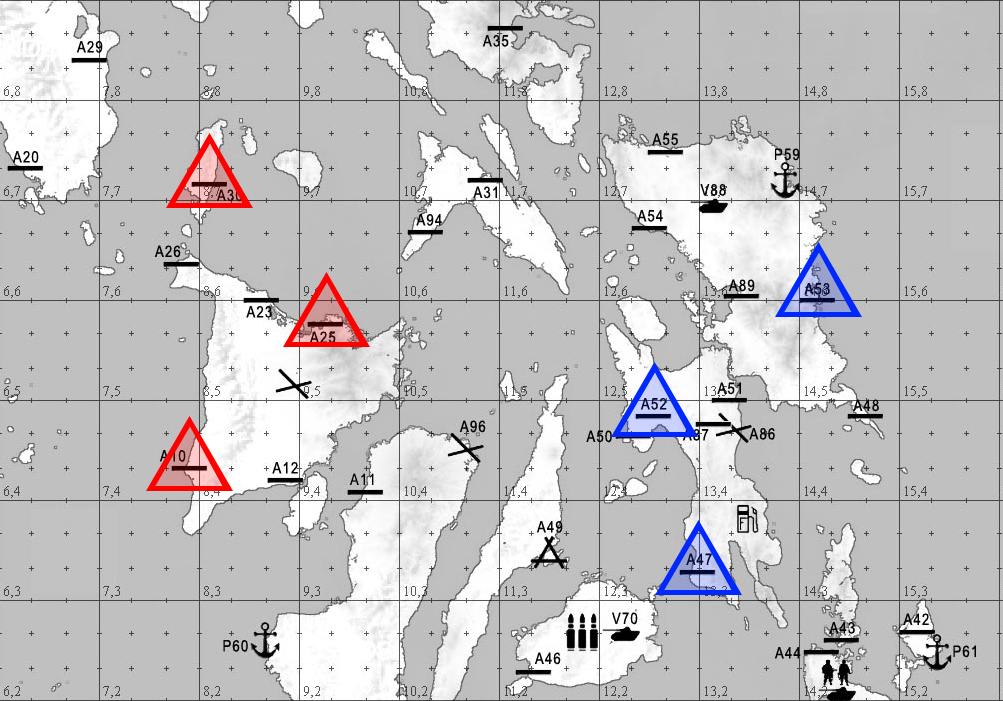
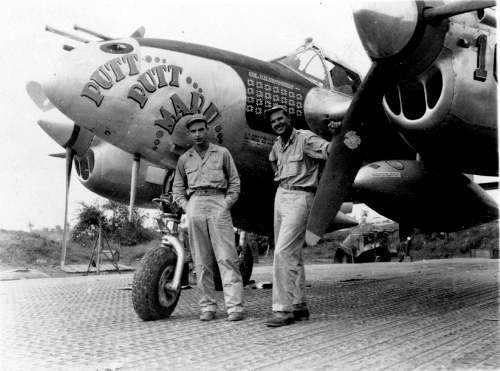
Frame 3 - Lt Joel Paris III (USAAF) - Paris flew the P-40 series in New Guinea and later the P-38 in the Philippines for the 7th FS, 49th FG. Credited with 9 victories in total he shot down 5 of them during the last week of December, 1944. He was awarded the Silver Star during the invasion of Mindoro when he shot down two Zero fighters while escorting a PBY floatplane to the island. Paris retired from the USAF as a Major General.
- Icon Range - Friendly 3k, Enemy 3k.
- No Radar
- Fighter and Bomber Warning Range - 63360 (12 miles)
- Tower Range - 63360 (for display to match the above Fighter and Bomber Warning)
- External view for bombers (F3) - On
- Friendly Collisions - Off
- Enemy Collisions - On
- Kill Shooter - Off
- Fuel - 1.0
- Ack - 0.3
- No Radar
- Fighter and Bomber Warning Range - 63360 (12 miles)
- Tower Range - 63360 (for display to match the above Fighter and Bomber Warning)
- External view for bombers (F3) - On
- Friendly Collisions - Off
- Enemy Collisions - On
- Kill Shooter - Off
- Fuel - 1.0
- Ack - 0.3
- Formations - Enabled
- Bombsite calibration - Main Arena Standard
- Visibility - 17 miles
- Object Downtime full (200)
- Winds - None
- Visibility - 17 miles
- Object Downtime full (200)
- Winds - None
- Extreme Downdraft at 20K
Original Design by Stoney 2009
Edited by Nefarious 2012 and 2023
Please take the time to contact your squads and ask what their choice of rides would be.
You can contact all the squads on your side here.
Please note the updated rules.
- Details
- Written by: Erich Msybsum
- Category: Pacific Theatre
- Hits: 20
>
/>
Murderer's Row: The Marianas
Turkey Shoot
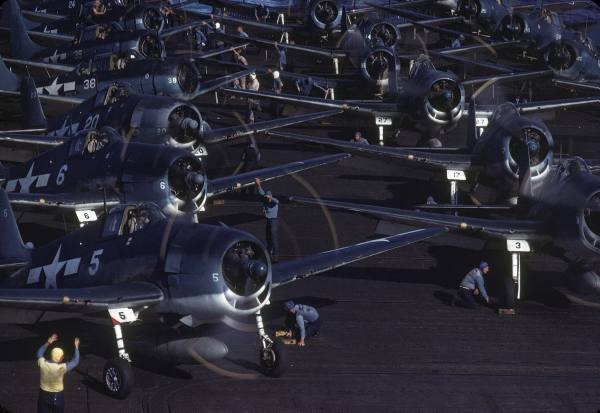
June 19th, 1944
From Clash of the Carriers by Barrett Tillman
The first battle of the
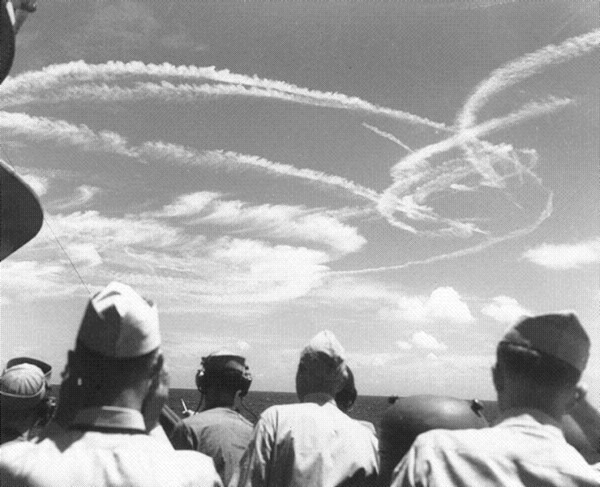
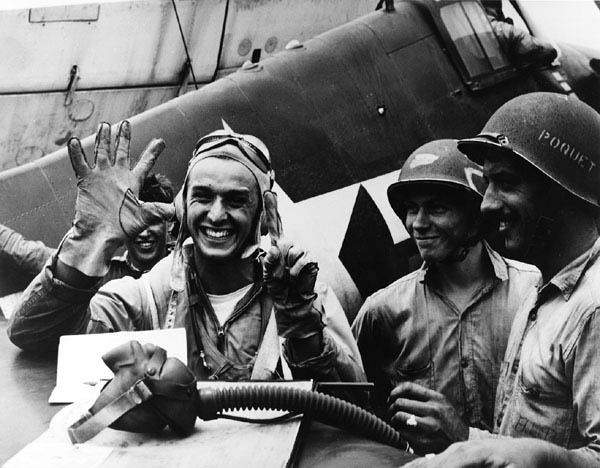
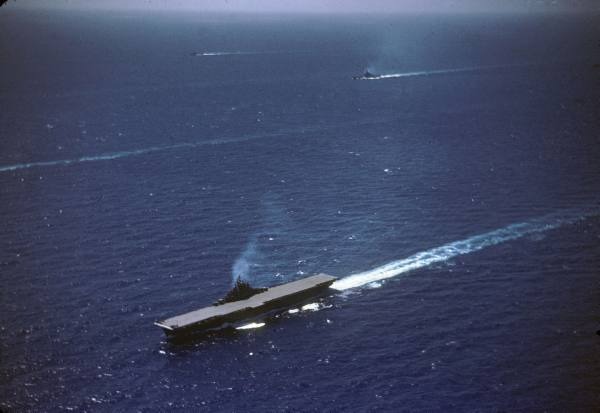
This FSO Setup will attempt to recreate the air battle that took place over the
-
Frame 1- July 10th, 2009- (0600 Tower Time)
-
Frame 2- July 17th, 2009- (1100 Tower Time)
-
Frame 3- July 24th, 2009- (1700 Tower Time)
- F6F-5
- SBD-5
- TBM-3
Axis:
- A6M5b
- B5N2 (get a 2nd life in A6M5b)
- D3A-1
- Ki-61 (Sub for the D4Y-1 must carry bombs and attack ships as primary role)
NOTE: The aircraft requirements will vary per-frame, please refer to the objectives for the appropriate numbers.
Side Split-
45% Allies
55% Axis
Scoring:
Will be points based, with an even split between Air-to-Ground (A2G) points and Air-to-Air (A2A) points. Each object at an assigned target (that can be destroyed) will have an assigned point value. The attacker will score points for each object destroyed, and the defender will score points for each object that is not destroyed at that target.The point value of each pilot will be determined by the total A2G potential points divided by the number of pilots who actually fly in the frame.Aircraft Scoring:
You will score Air-to-Air (A2A) points in the following two ways.- Each enemy aircraft shot down
- Each successful landing in an aircraft prior to the end of frame ( landing as a gunner will not count )
Ground Targets:
Players will earn points for objects destroyed on the ships even if they are not sunk.
- Aircraft Carrier (CV)- 2094
- Cruiser (CA)- 1471
- Destroyer (DD)- 1021
Arena Settings:
- Terrain ? bigocean
- Icon Range ? Short
- Radar ? Off
- Fighter and Bomber Warning Range ? 10,560 -2 miles
- Tower Range ? 10,560 (for display to match the above setting)
- Visibility ? 17 miles
- Wind: None
- Clouds: TBD
- External view for bombers (F3) ? On
- Friendly Collisions ? Off
- Enemy Collisions ? On
- Kill Shooter ? Off
- Fuel ? 1.0
- Ack ? 0.2
- Time ? (See Objectives)
- Bombsite calibration ? MA standard
- Evening- 2100
Specific Rules:
- Ki-61's must be used as dive bombers, therefore they must launch with bombs and attack the specified targets.
- F6F-5's may NOT carry rockets or 1000 pound bombs.
- There will be backup recovery carriers in clearly marked sectors of the objectives. Do not attack the recovery carriers.
- B5N pilots will get a 2nd life in A6M5b's
You can contact all the squads on your side here.
http://ahevents.org/fso_email/mail_address.html
Please note the updated rules.
- Details
- Written by: Darren F. Gideon
- Category: Pacific Theatre
- Hits: 21

1943: Operation Husky, The Invasion of Sicily
t=utf-8" />
-PHP 2.6.1">
DESCRIPTION
At the Yalta Conference in Feb 1945, Joseph Stalin had agreed to end the non-aggression pact with
The main invasion came across the
While the main invasion came across from the west, the eastern pincer made several amphibious landings on 18 Aug in northern
On 14 Aug 1945, through a radio address, Emperor Hirohito of
The Japanese northern-most home
This FSO is a what if scenario which posits that
NOTE: We will be using the
|
SOVIET AIRCRAFT
|
|
JAPANESE AIRCRAFT
|
|
A-20G LA5N
YAK-9U
YAK-9T
T-34
M-3
|
|
Ki-61
Ki-67
Ki-84
Panzer
M-3
M-8
|
COUNTRY PERCENTAGES
Roughly 50 / 50 with the Axis having slightly more.
SCORING
CA - 40 points
DD - 20 points
5 pts - Single Engine AC with 1 crew
10 pts - Single or double engine AC with 2 crew
15 pts - Double Engine AC with 3+ crew
192 - Small Airfield
264 - Medium Airfield
381 - Large Airfield
TBD - Port
146 - Vehicle Base
ARENA SETTINGS
- Japan Terrain
- Fuel 1.0
- Icons short
- 0.5 Ack
- Fighter and Bomber warning range 52,000 (about 10 miles)
- Tower range set to 52,000 (for display only to match the above setting)
- Clouds / visibility
Frame 1, 13 miles
Frame 2, 23 miles
Frame 3, 16 miles
- Radar off
- Formations off - Friendly collisions off
- Kill shooter off
- Calm winds
- Time: 11 AM
SPECIAL RULES
Note special rules sent out with the objectives trump these special rules.
1. Nobody on the allied life gets a second life flying a plane.
2. Bomber formations are enabled / available.
3. A minimum and maximum number will be assigned to each aircraft type. The CiC of each side must deploy the designated minimum per aircraft type and can not more than the maximum per aircraft type. Outside of that the CiCs can deploy the aircraft types anyway the want (i.e. can have squads fly 2 aircraft types and in split they wish as long as squads are assigned same objective).
4. If both CiCs agree they may have the setup CM end the frame early. This is usually done if one side wipes out the other side (i.e. 60 versus 5).
5. Dead pilots may gun bombers. They may not man the guns of airfields or ships.
6. Ships can maneuver by the allied side during the frame as long as they stay in their containment area. Ships must stay in containment area defined in the objective orders. If they go outside of the containment area a penalty will be assessed.
7. All targets must be attacked within the first hour of the event. Both CiCs should include sending their battle plans to me so that I have proof that they planned to attack their targets by T+60.
8. All targets must be attacked by a credible force. I define a credible force to be at the very least 2 x 4-6 squads (so 8-12 planes) or 1 7x10 squad. Obviously CiCs can deploy a larger force per target as their plan dictates but no defending or attacking with just 1 x 4-6 squad.
9. All targets must be defended by a credible force. I define a credible force to be at the very least 2 x 4-6 squads (so 8-12 planes) or 1 7x10 squad. Obviously CiCs can deploy a larger force per target as their plan dictates but no defending or attacking with just 1 x 4-6 squad.
GROUND RULES
A ground combat element will be incorporated into the event. Specific rules regarding the ground combat will be forth coming. Basically I will be using the same rules and capture the flag idea that was used in the Tunisia FSO
First off the ground combat will be a type of capture the flag. Both sides will spawn outside of a base not controlled by either and will be tasked with capturing the neutral (third party base) and holding it until end frame (so a sort of capture the flag but with a stationary flag).
Also GV life might either be a one life affair for those assigned to GVs or if I determine that the GV players get a second life in planes later in frame they will not be allowed to up in planes until after a specific time marker (i.e. T+40 or T+50, etc. ... it is to TBD). However dead GV players may man the guns of other tanks and vehicles.
- Details
- Written by: Spikes
- Category: Pacific Theatre
- Hits: 18
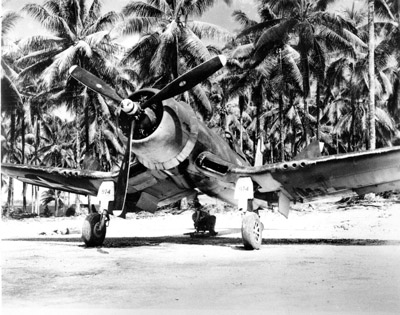
BOUGAINVILLE PRIVATEERS: Solomons 1943
As 1943 drew on Imperial Japan was forced to rethink its war strategy in view of the Allied successes in New Guinea and Guadalcanal, especially on the heels of her catastrophic defeat at Midway the previous year. Everywhere in the Pacific Japan's forces were stretched too thin. Contraction of the Empire's territories seemed the only answer while buying time for defensive preparations to thwart the renewed Allied strategic offensives Japan's GHQ knew would come. In the Pacific Area Nimitz was preparing to assault the Gilbert Islands. In the South West Pacific Area MacArthur was continuing the clearance of the New Guinea coast supported by Halsey's South Pacific Area which aimed to overrun the Bismarck Archipelago. In the Solomons Halsey was driving up the island chain to capture New Georgia and Bougainville and further isolate Japan's fortress base at Rabaul in New Britain.
By the time the U.S. was preparing to invade Bougainville in September of 1943 both sides were deploying improved fighters in quantity. Examples included the P-38 Lightning and the F4U-1 Corsair which joined the stalwarts like the venerable P-39 and P-40. On the Japanese side veteran fighters like the Ki-43 were joined by the new A6M5 'Type 0' making its combat debut. Aces from both sides like Warrant Officer Hiroshi Okano of the IJNAFs 201st Air Group and USMC 1st Lt. Edwin L Olander of VMF-214 looking for action over "The Slot" would often find it.
This event recreates the contest that took place between the opposing air fleets as they fought a grinding war of attrition in the skies of the Solomon Islands in that fall of 1943.
Country Percentages:
Axis 50%
Allied 50%
Allied 50%
Field Assignments:
Axis Bishop
Allied Knight
CM Rook
OOB:
Allied Knight
CM Rook
OOB:
Axis (IJAAF/IJN):
A6M5 (max 24)
A6M3
Ki-61 (max 24)
Ki-43
G4M1
Allied (USAAF/USN/USMC):
P-38G (max 24)
P-40F
P-40F
P-39N (P-39Q)
F4U-1A (max 24)
SBD-5
B-25C
SBD-5
B-25C
Special Rules and Ordnance Restrictions:
* All aircraft types must be used with a minimum of 12 *PLAYERS*.
* A min of 24 players must be assigned to each mission objective.
* Bombers are limited to 18,000 feet alt.
* Bombs larger than 500 lbs are not enabled for the Allied side.
* Gondolas are disabled on the P-39.
* Air-ground ordnance is disabled for fighters.
Scoring:
Aircraft Pts
------------
------------
Bombers: 5 pts
Dive bombers: 3 pts
All other aircraft: 2 pts
Landing bonus: 2pts
Ground Target Pts
Ground Target Pts
-----------------
0.5 = Gun
25 = Hangar
3 = All other
Arena Settings:
- Solomons terrain
- Fuel burn 1.0
- Icons short (3k)
- 0.3 Ack
- Fighter and Bomber warning range 42,000 (about 8 miles)
- Tower range set to 42,000 (for display only to match the above setting)
- Haze/fog full visibility (17 miles)
- Radar off
- Enemy collisions on
- Friendly collisions off
- Killshooter off
- Time: 15:00 ( 3PM ) Game Clock
- Formations: On
- Bomber calibration: Auto ( MA style )
- Task Group Hardness 2.0
- Fuel burn 1.0
- Icons short (3k)
- 0.3 Ack
- Fighter and Bomber warning range 42,000 (about 8 miles)
- Tower range set to 42,000 (for display only to match the above setting)
- Haze/fog full visibility (17 miles)
- Radar off
- Enemy collisions on
- Friendly collisions off
- Killshooter off
- Time: 15:00 ( 3PM ) Game Clock
- Formations: On
- Bomber calibration: Auto ( MA style )
- Task Group Hardness 2.0
- Wind: 0-2K NO WIND
2-10K NE TO SW - Speed 5
10-18K NE TO SW - Speed 5
18K+ N TO S - Speed 10
Designer's Notes:
2-10K NE TO SW - Speed 5
10-18K NE TO SW - Speed 5
18K+ N TO S - Speed 10
Designer's Notes:
Design by Warloc
- Details
- Written by: Steven Jackson
- Category: Pacific Theatre
- Hits: 19
MIRACLE AT MIDWAY!
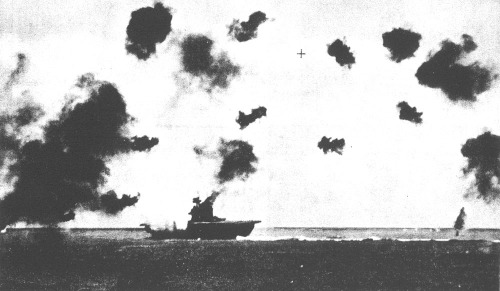
USS Yorktown takes a direct hit from a Japanese aerial torpedo
June, 1942...
Even though the Japanese invasion of Port Moresby had been repulsed in the Coral Sea, things continued to look bleak for the Allies in the Pacific. The U.S. Navy was still recovering from the loss of so many ships at Pearl Harbor a mere 7 months prior. The USS Lexington had been sunk, and the USS Yorktown heavily damaged during the Battle of the Coral Sea. With just a fraction of its former naval strength, the US Pacific Fleet was badly in need of a reprieve. Unfortunately, the Imperial Japanese Navy would not allow time for the US Navy to recouperate. The IJN staff had planned their operations precisely, with the objective of either spreading the US Navy too thin or destroying its carrier fleet in a progression of battles that spanned the entire breadth of the Pacific Ocean. The next part of their plan was a two-pronged thrust into the middle and north Pacific, with one attack into the Aleutians and another attack aimed at capturing Midway Island. The attack on the Aleutians was planned to either pull the U.S. Fleet north and away from Midway, or to provoke a full-scale battle where the Japanese could both destroy the US Pacific Fleet, and capture Midway unmolested.
For Admiral Nimitz, Commander of the US Pacific Fleet, it seemed a miracle was needed...
In Pearl Harbor, US Naval intelligence had given Admiral Nimitz his first glimmer of hope--they had successfully broken the IJN signal code used to encrypt messages between their commands. Through a saavy signals intelligence effort, Admiral Nimitz was armed with early warning of Japanese intentions. Knowing that Midway was going to be attacked, Nimitz was able to make a deliberate plan on how to engage and defeat the Japanese. A second cause of encouragement was that the USS Yorktown, through one of the most improbable repair efforts in the history of naval warfare, was made sea-worthy and operationally ready in just four days in dry dock. Perhaps the needed miracle was taking shape?
This setup will attempt to recreate the events of 4 June, 1942 in three frames.
Frame 1: 07 November, 2008 (1000 T - Time)
Frame 2: 14 November, 2008 (1200 T - Time)
Frame 3: 21 November, 2008 (1400 T - Time)
Scoring:
Objective based scoring will be used. 50% of each frame's score will be for air-to-air kills, with the remaining 50% being divided between 4 air-to-ground objectives each frame. Each air-to-ground objective will be worth a total of 12.5 points. Objective scores will be based on victory criteria that will be published in each frames objectives.
Air-to-Air
Air-to-air score will be worth 50 potential points each frame. The total number of aircraft that lift for each side will be tallied and added together using their respective point totals. That number is the total aircraft potential for each side. All single engined fighters will be worth 1 point. All aircraft with multiple crewmembers will be worth 1.25 points. To reach the percentage score, the total points scored will be divided by total aircraft lifted. For example, if 60 F4F, 20 SBD, and 14 TBM aircraft launch, and 20 F4F, 10 SBD, and 2 TBM aircraft are shot down, the Japanese would score (20) for F4F, (12.5) for SBD, and (2.5) for TBM. The total value destroyed (35) is divided by the total number launched (94) to get a percentage (37%). That percentage is used to modify the 50 potential air-to-air points i.e. (35) / (94) = 37%; 50 X .37 = 18.5. So, in this example, the IJN would score 18.5 points for air-to-air victories.
Air-to-Ground
Air-to-ground score will be worth 50 potential points each frame. Each of the 4 target objectives will be worth 12.5 points to either side. The USN and IJN will be awarded points based on victory conditions listed in each frame?s objectives. Target objectives will consist of ship targets for the USN and ship targets and the airfield and installations on Midway for the IJN only. Each objective will have its own victory conditions that will define who receives points, and for what destruction criteria. Both sides will have an equal potential to score the same points for each objective.
Plane Set:
US Navy
F4F-3 (80 maximum; 4X.50 cal armament only)
SBD-3 (96 minimum)
TBM-3 (36 minimum; torpedoes only--no rockets, no bombs)
Japanese Navy
A6M2 (100 maximum)
D3A (120 minimum)
B5N2 (50 minimum)
Special Rules:
Manual calibration will be used for bombers
Arena Settings:
--Midway Map
--Fuel Burn 1.25
--Icons Short
--.2 Ack
--Fighter and Bomber Warning Range 48,000 (~8 nautical miles)
--Tower Range 48,000 (~8 nautical miles, To Match Warning Range)
--Visibility 17 Miles
--Wind speed will vary with altitude
--Radar Off
--Enemy Collisions On
--Friendly Collisions Off
--Killshooter Off
--Takeoff time per frame descriptions above
Contact all the squads on your side at:
http://ahevents.org/fso/view_assignments.html
Updated FSO Rules at: