- Details
- Written by: Spikes
- Category: Pacific Theatre
- Hits: 16
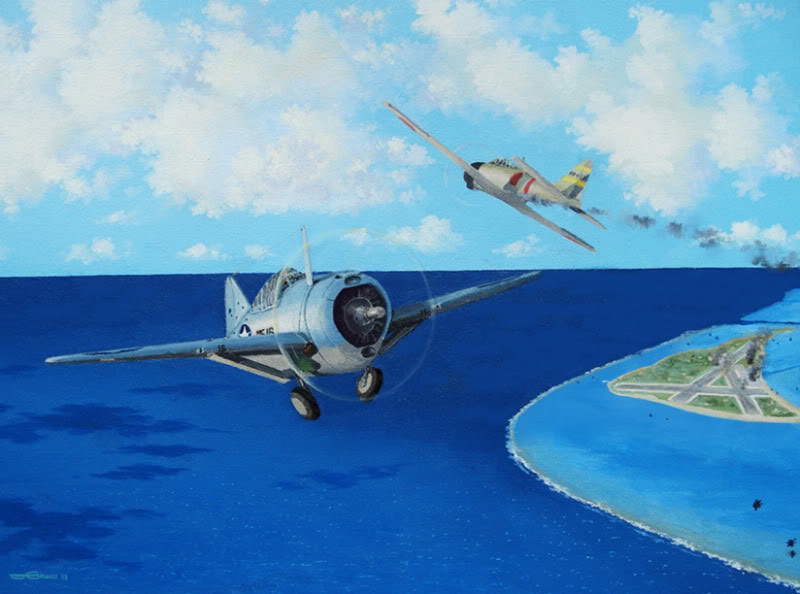
Head On at Midway 1942
Introduction
At 0300 4 June, when reveille sounded on Midway, the Japanese Fleet was approaching its objective in two main forces, the Striking Force, commanded byAdmiral Nagumo, Chuichi, IJN; and the Occupation Force, under over-all command of Vice Admiral Kondo, Nobutake, IJN. The former unit, as we have seen, was composed of four carriers, plus an escort of battleships and smaller combatant ships; and the latter included a substantial portion of the Second Fleet: Battleships, cruisers, and the amphibious shipping necessary to mount the projected landing operation against Midway, the objective now designated by the Japanese code term as "AF." At this time the striking force was approximately 250 miles northwest of the atoll, engaged in making final preparations to launch planes which were intended to wipe out Midway as an effective air base and pave the way for its assault and occupation. The occupation force, which had been attacked from the air without appreciable damage during the day and night previous, was almost due west of Midway, approximately 450 miles away.
At 0430, only 15 minutes after an early dawn search group of 11 PBY's had been sent out from Midway to locate his Striking Force, Admiral Nagumo headed carriers upwind and launched the Midway Attack Force, composed as follows:
First wave: 36 carrier attack planes.
Second wave: 36 carrier bombers.
Third wave: 36 fighters.
Meanwhile, after the PBY's had gone out, Midway devoted itself to final preparations for battle. Marines of the ground defense force were at general quarters, manning every weapon and warning device; the pilots and ground crews of MAG-22, which already had fighters aloft to cover the sortie of the PBY's, were standing by for orders. The latter were not long in coming.
At 0552, moreover, after apparently trying to get this vital message through for almost a quarter of an hour (see footnote 6), a PBY reported visual contact with two enemy carriers and the balance of the Japanese main body, some 180 miles from Midway, bearing 320 degrees. Three minutes later, at 0555, the 6th Defense Battalion logged a radar report, "Many planes, 89 miles, 320 degrees." Almost simultaneously, the Naval Air Station noted substantially the same contact. In a matter of seconds, the air-raid sirens were sounding, Condition One was set, and the pilots of MAG-22 were manning their planes. Within less than 10 minutes, both squadrons of the Marine Air Group were in the air and being vectored toward their respective targets. VMF-221 was to intercept the massed carrier air of the Midway attack force, and VMSB-241 would rendezvous 20 miles east of Midway, at which point further instructions would be issued.
Commanded by Major Floyd B. Parks, VMF-221 was a squadron of mixed composition, being equipped mainly with Brewster F2A-3's, augmentedby a few F4F-3's of the type which had already drawn blood at Wake. On this morning, 26 airplanes were operational out of the squadron's 28. At 0616, approximately 30 miles from Midway, from an altitude of 14,000 feet, the pilots with Major Parks saw 2,000 feet below them a large formation of Aichi Type 99 (Val) dive bombers screened by several divisions of Zero fighters. Captain John F. Carey, leading one of Park's divisions in an F4F-3, gave "Tally-ho," and pushed over into a dive to attack the bombers, followed by his wingmen, Captain Marion E. Carl and Second Lieutenant Clayton M. Canfield. As Carey and Canfield commenced high-side runs on the bombers, Carl and other pilots of the squadron mixed it with a swarm of Zero fighters which, they noted, climbed astoundingly even in comparison to the Grumman's, let alone the F2A's. Inasmuch as only three of the original 12 Marine pilots of Major Park's group survived this unequal encounter, it is impossible to reconstructdetails of the melee, but survivors' accounts, together with evident results observed subsequently, indicate that the first attack took a formidable toll of the enemy bombers and even a few of the 36 covering Zeroes.
Join the Aces High FSO Team as we present a different look a the Battle of Midway. That pits man a machine against each other in a desperate battle to attack and defend above the Island of Midway.
Side Split
Axis 50%
Allies 50%
Planeset
Axis
Mitsubishi A6M2 (12) Min
Mitsubishi A6M3 Unlimited
Aichi D3A1 (12) Min
Nakajima B5N2 (12) Min
Allied
Brewster F2A (12) Min
Grumman F4F-3 Unlimited
Dauntless SBD-5 (12) Min
Grumman TBM-3 (12) Max
Ordnance Distribution (Loadouts)
Axis
Aichi D3A1 - 1x 250kg bomb, 2x 50kg bombs
Nakajima B5N2 - 1x 800kg torpedo or 3x 250kg (550lb) bombs
Allies
Grumman F4F-3 - 4x 50 Cal. only
Dauntless SBD-5 - 1x 500lb bomb and 2x 100lb bombs
Grumman TBM-3 - 1x 2000lb torpedo or 4x 500lb bombs
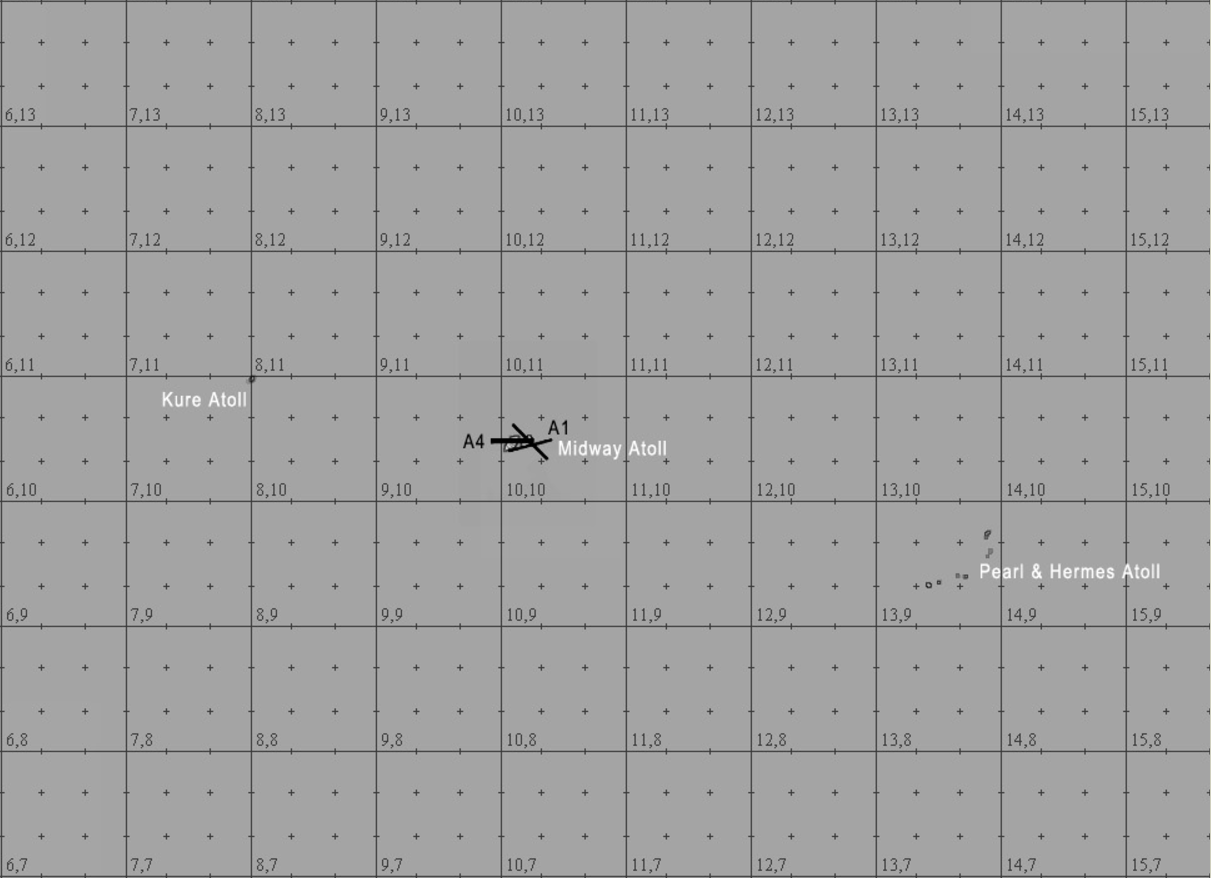
Terrain
Special Event Rules and Ordnance Restrictions
- This is a one life event. Pilots may not re-plane at their home airfields.
- Ordnance for each aircraft will be set by the setup CM in the hangar.
- Aircraft may rearm and refuel at any friendly base. Aircraft should be landed before frame’s end at any friendly base.
- All assaults must be made by no less than 10 attacking aircraft.
- All destroyed objects stay down for the entire frame.
- All Hangars, Cruisers and Destroyers will have the same destruction weight of 2800 lbs.
- The Aircraft carriers will have a destruction weight of 5,000 lbs.
- Aircraft icons appear above 18k.
- Altitude CAP for aircraft carrying bombs will be 18k.
- Altitude CAP for fighters will be 23k.
Scoring
Single Engine Fighter - 1 pt.
Single Engine Attack - 2 pts.
Hangars =10 pts.
Ships = 10 pts. (Aircraft carries carry a 5 point bonus for sinking.)
Arena Settings
•Terrainmap: Midway
•Fuel burn rate: 1.0
•Anti-aircraft gun strength: 0.5
•Bombsight calibration: AUTOMATIC (MA standard)
•Icons: 3.0K yards (9,000 feet)
•Sector Radar ("bar dar"): OFF
•Dot Radar: OFF
•Fighter and Bomber warning range: 26,400 feet (5 miles)
•Tower range set to 26,400 feet (for display only, to match the above setting)
•Haze range: 12 miles
•Friendlycollisions: OFF
•Enemy collisions: ON
•Kill shooter: OFF
•Stall Limiter: Set ON (Players may disable)
Wind:
Altitude Speed Direction
00 - 02K 0 NO WIND
02 - 10K 05 W -> E
10 - 18K 13 W -> E
18 - 26K 27 W -> E
26 - 30K 38 W -> E
Arena Clock:
Frame 1 0930 (9:30 AM, Morning)
Frame 2 1100 (11:00 AM, Morning)
Frame 3 1400 (2:00 PM, Afternoon)
ACE MISSIONS
Each side will have one mandatory Ace mission per frame. These frames will represent notable pilots of the time and theater. One pilot from each side will be designated an "Ace" Pilot. They must fly the Aces listed aircraft. The Aces must be relayed to the Admin CM before launch. They will be scored as follows.
Ace Pilot = 20 Points (Opponent Score)
Ace Pilot Kills = 20 Points
So for example if an Ace Pilot is shot down they are worth 20 points to the other side. Likewise, every victory an Ace Pilot lands they will be rewarded 20 points.
IJN/IJA
Frame 1 - A6M2 Zero - Shimakawa Masaaki was a warrant officer and ace fighter pilot in the Imperial Japanese Navy (IJN) during the Pacific theater of World War II. In aerial combat over the Pacific he was officially credited with destroying eight enemy aircraft with 12 or 13 assists. Shimakawa was a member of the Tainan Air Group at the beginning of the Pacific War. Often assigned as a wingman to legendary ace Saburō Sakai, Shimakawa fought in the conquest of the Philippines and the Dutch East Indies campaign. In April 1942, Shimakawa was transferred to the aircraft carrier Kaga's fighter group, with which he participated in the Battle of Midway.
Frame 2 - A6M2 Zero - Kaname Harada was a Japanese flying ace of World War II. He was credited with shooting down as many as 19 Allied aircraft between late 1941 and when he was himself downed in October 1942. During the Battle of Midway, Harada shot down either three or five American aircraft. After recovering from the injuries sustained in this incident, Harada served as a flying instructor for the remainder of the war.
Frame 3 - A6M3 Zeke - Iyozoh or Iyozo Fujita was a Japanese Lieutenant Commander in the Imperial Japanese Navy Air Service during World War II. He was credited with 11 to 42 victories.
USN/USMC
Frame 1 - F2A Buffalo - Charles Kunz was born on November 7, 1919, in Dixon, Missouri. He enlisted in the U.S. Marine Corps on November 15, 1940, and entered the Aviation Cadet Program on February 15, 1941. Kunz was commissioned a 2d Lt in the Marine Corps and designated a Naval Aviator on September 6, 1941, and then completed fighter training at San Diego, California, before joining VMF-221 at Midway in February 1942. Lt Kunz was credited with the destruction of 2 enemy aircraft during the Battle of Midway while flying the F2A-3 Buffalo on June 4, 1942. He was wounded in this action, and joined VMF-224 in Hawaii the same month. Lt Kunz deployed to Guadalcanal in August 1942, and was credited with the destruction of another 6 enemy aircraft in aerial combat flying the F4F-4 Wildcat before returning to the U.S. in November 1942.
Frame 2 - F2A Buffalo - Marine Lieutenant Colonel Marion Carl, one of the war’s acclaimed fighter aces in his own right with 18½ kills to his credit. The first of these came on June 4, 1942, when Captain Carl was assigned to Marine Fighting Squadron (VMF) 221 on Midway Atoll. He had arrived there on Christmas Day in 1941, flying an F2A-3 Buffalo from the carrier Saratoga (CV 3).
Frame 3 - F4F -3 Wildcat - Colonel James E. Swett United States Marine Corps fighter pilot and ace during World War II. He was awarded the United States' highest military decoration, the Medal of Honor, for actions while a division flight leader in VMF-221 over Guadalcanal on April 7, 1943. Subsequently he downed a total of 15.5 enemy aircraft during the war, earning eight Distinguished Flying Crosses and four Air Medals.
Designer Notes:
Designed by – AKWarhwk June 2017
- Details
- Written by: Zach Wood
- Category: Pacific Theatre
- Hits: 20
Â
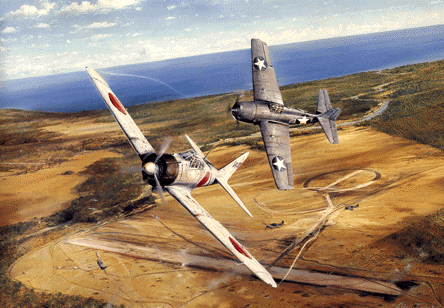
1942 was a very exciting year in the Pacific for the United States, and the Empire of Japan. Given that the United States Navy had been almost wiped out at Pearl Harbor, 1942, was the year that essentially determined the outcome of the war in the Pacific. With US Victories at Coral Sea, and Midway, the allies turned to the Solomon Islands as their next campaign. The first goal was to prevent Japanese forces from interfering with the supply routes between the United States and Australia. The second goal was to eventually use Guadalcanal and Tulagi as a staging area for future attacks on the fortress of Rabaul.
The key focus of this event is the air to air fighting that occurred over, and around Guadalcanal. Both the United States, and the Japanese fought tooth and nail for the Island. Henderson field was bombed, or shelled almost daily by both the IJAAF and the IJN. Our event takes place in October of 1942, where the fate of Guadalcanal was decided. Both sides were locked in bitter fighting on the ground, at sea, and in the air, for control over the island. This area would seal the fate for one side, or the other.Â
During this campaign the air attacks made by the Japanese consisted of attacks made by fighters, and bombers alike from both the IJAAF, and the IJN. The Cactus Air Force, based at Henderson Field, defended the island and was a mix of Army, Marine and Naval aviators. Both sides operated in inhospitable terrain with supplies and replacements hampered by the distance of the supply lines. Aces such as Joe Foss (USMC), "Buzz" Wagner (USAAF), Stanley W. "Swede" Vejtasa (USN), Hironojo Shishimoto (IJAAF), and Saburo Sakai (IJAAF) all made their names at this time. This FSO recreates the action over Guadalcanal in October of 1942.
Frame One & Two, both focus on the defense of Henderson Field by the Cactus Air Force, and the defense of Japanese supplies and Reinforcements being brought in by sea. These two frames will have the Japanese forces launching attacks on Henderson, while the Cactus Air Force is attacking a Japanese Convoy, attempting to drive the Japanese Navy away from Guadalcanal.
Frame Three will focus on the Battle of Santa Cruz, which will pit the US Navy against the Japanese Navy. Both sides will be attacking and defending one another's fleets in the final frame. The battle will take place just to the East of Guadalcanal, and both sides are allowed to use land based planes as well in an attempt to destroy the designated fleets.Â
Country Percentages:
Axis 50%
Allied 50%
Field Assignments:
Axis Bishop
Allied Knight
CM Rook
OOB:
Axis (IJAAF/IJN):
A6M2 (MIN 24)
A6M3 (MAX 18)
KI-43 (MAX 24)
G4M1 (MIN 12)
D3A1 (MIN 12)
B5N (available for Frame Two & Three Only)
Allied (Cactus Air Force/USN):
B-25C (MIN 12)
F4F-4 (MIN 24)
P-39D (MIN 24)
P-40F (MAX 18)
SBD-5 (MIN 12)
B5N (available for Frame Two & Three only)
Special Rules and Ordnance Restrictions:
* All aircraft types must be used by a minimum of 12 *players* unless otherwise noted.
* All bombers are limited to 20,000 feet.
* Formations are enabled for all bombers.
* ALL AIRCRAFT ARE TO BE LANDED AND THE PLAYERS TOWERED OUT BY FRAME END OR WILL BE CONSIDERED SHOT DOWN AND THE CREWS KIA.
*B5N is used as balance by both sides and all bomb options are disabled.
*Ships must stay in containment area.
Scoring:
Aircraft Pts
------------
AXIS:
Bomber = 10 pts
Dive Bomber = 10 pts
Torpedo Bomber= 8 pts
Fighter = 5 pts
Landing Bonus = 2 pts
ALLIED:
Bomber = 10 pts
Dive Bomber= 10 pts
Torpedo Bomber=8 pts
Fighter = 5 pts
Landing Bonus = 2 pts
Target Pts
-----------------
Destroyer = 50 pts
Cruiser = 100 pts
Carrier = 200 pts
Gun = 0.5 pts
Hangar = 25 pts
All others = 3pts
Arena Settings:
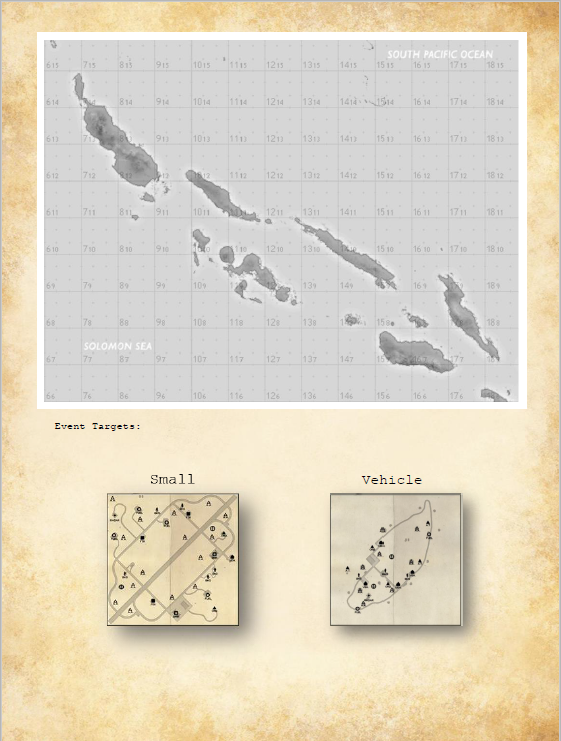
- Solomon's terrain
- Fuel burn 1.0
- Icons friendly 3k/enemy 3k
- 0.4 Ack
- Fighter and Bomber warning range 42,000 (about 8 miles)
- Tower range set to 42,000 (for display only to match the above setting)
- Haze/fog full visibility (17 miles)
- Radar off
- Enemy collisions on
- Friendly collisions off
- Killshooter off
- Time: Frame One: 0600 Frame Two: 1200 Frame Three: 0730
- Formations: On
- Bomber calibration: Automatic
- Wind: 0K-18K 0 Speed
          18K-24K SE TO NW - Speed 10
          24k+ SE TO NW - Speed 15
Designer's Notes: The P-39D represents the P-39 and P-400.
Design by BFOOT1
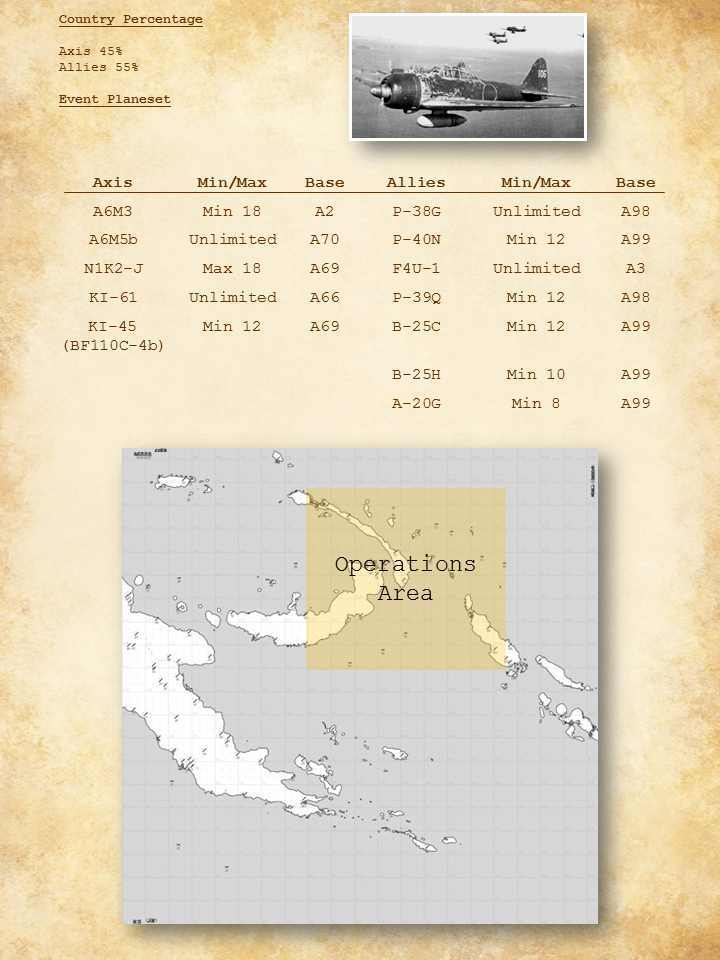
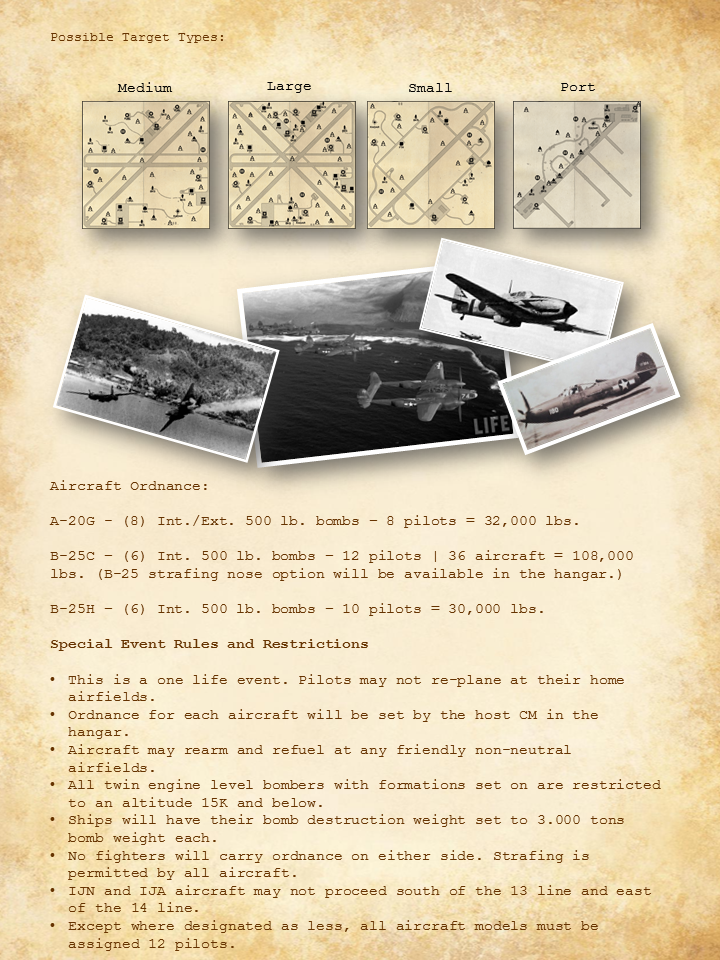
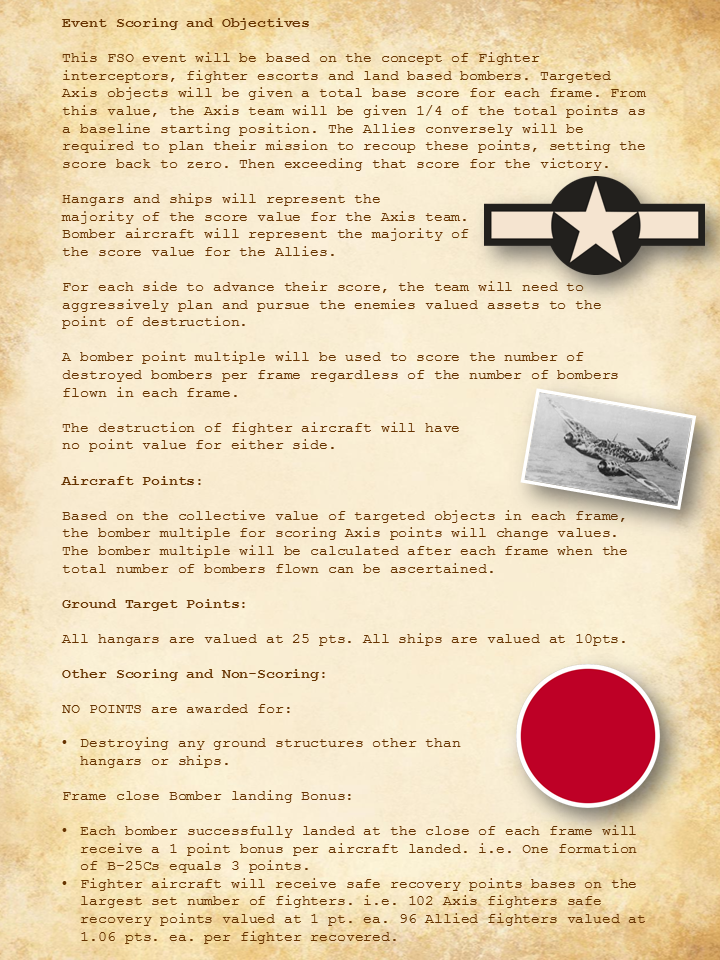
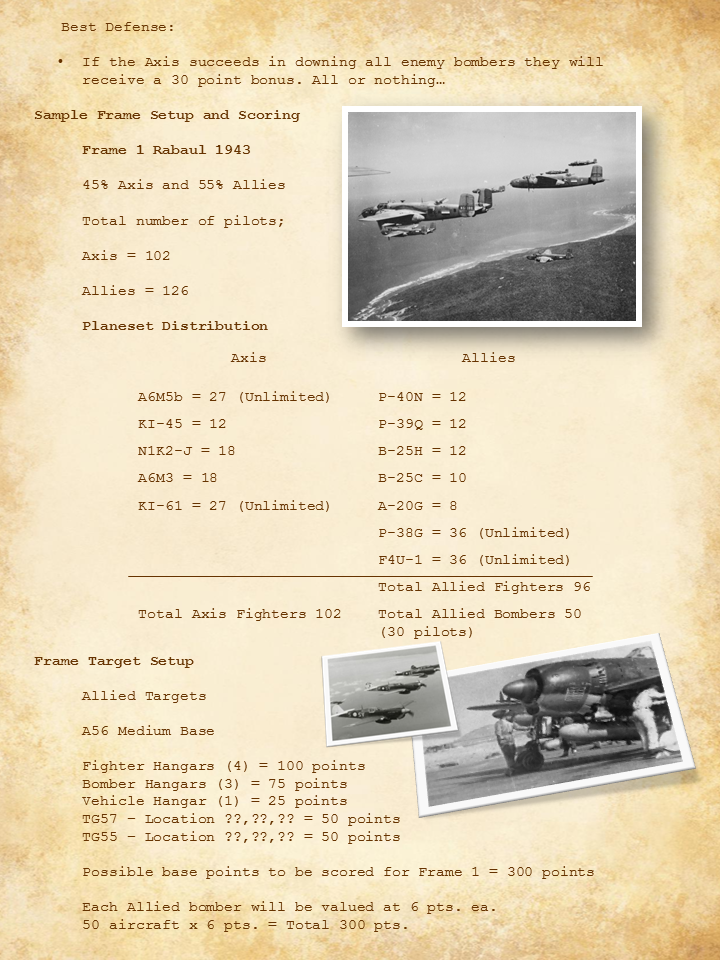
- Details
- Written by: Spikes
- Category: Pacific Theatre
- Hits: 19
Country Percentages:
Axis 52%
Allied 48%
Field Assignments:
Axis Bishop
Allied Knight
CM Rook
OOB:
Axis (IJN/IJAAF):
A6M2 (min 24)
Ki-43-II
D3A1
G4M1
P-40E (max 16)
B-339D (Brewster, max 16)
Hurricane II
A-24 (SBD)
Special Rules and Ordnance Restrictions:
* All aircraft types must be used by a minimum of 12 *players*.
* Level bombers are limited to 18,000 feet max alt.
* The SBD is limited to the 500 lb and 100 lb bomb loads.
* The Brewster has the 4 x 50 cal armament option disabled.
* The Hurricane has the 20mm gun option disabled.
* Each frame has a naval battle at T+65 between cruiser task groups manned by downed players. Each CiC will designate the TG commanders. Victory will be determined by the side who sinks the most ships in points. Cruisers are worth 2 points and Destroyers 1 point. Aircraft will not be permitted in the naval battle. PT boats will not be enabled.
* ALL AIRCRAFT ARE TO BE LANDED AND THE PLAYERS TOWERED OUT BY FRAME END OR WILL BE CONSIDERED SHOT DOWN AND THE CREWS KIA.
Scoring:
Aircraft Pts
------------
Aircraft = 5 pts
Landing Bonus = 2 pts
Target Pts
----------
Gun = 0 pts
Hangar = 25 pts
Cruiser = 100 pts
Destroyer = 50 pts
All Other = 3 pts
Arena Settings:
- Newbrit terrain
- Fuel burn 1.0
- Icons friendly 3k/enemy 3k
- 0.3 Ack
- Fighter and Bomber warning range 42,000 (about 8 miles)
- Tower range set to 42,000 (for display only to match the above setting)
- Haze/fog full visibility (17 miles)
- Radar off
- Enemy collisions on
- Friendly collisions off
- Killshooter off
- Time: 15:00 ( 3PM ) Game Clock
- Formations: On
- Formation Autopilot: On
- Bomber calibration: Automatic
- Wind: 0K-10K NW TO SE - Speed 5
* The Dutch B-339D version of the Brewster F2A fighter was a de-navilised export model of the F2A-2. It was lighter than the USMC F3A-3 used at Wake and lacked the heavier equipment added to the Buffalo version of the RAF. It also had a 1200 hp engine the British model lacked. The combat record of the Dutch flown B-339s was reasonably good versus the Japanese. They lost 30 aircraft and 17 pilots killed while claiming 55 victories over Malaya and the East Indies.
Design by Warloc