- Details
- Written by: Spikes
- Category: Mediterranean Theatre
- Hits: 18
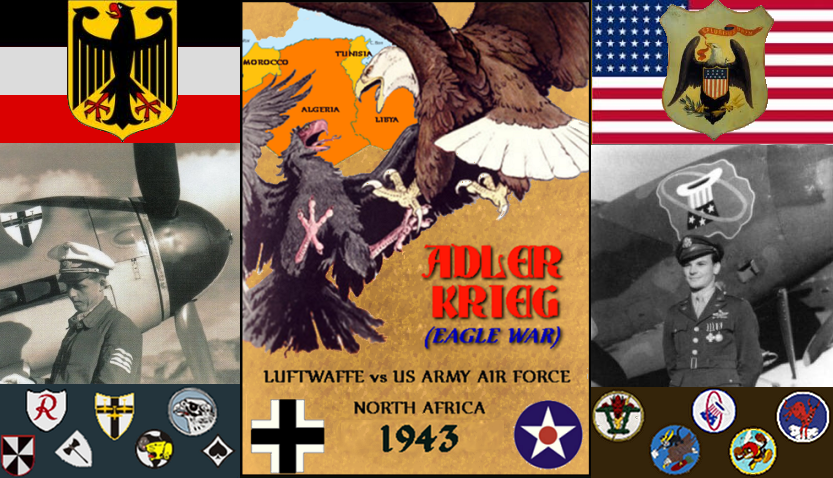
Â
USAAF:
P-39Q - Sub for P-39L and MÂ Â Â Â Â
P-38GÂ Â Â (30 Max)Â
P-40FÂ Â Â Â Â Â Â
Spit VÂ Â Â (24 Max)
Spit IXÂ Â (10 Max) Available Frame-3 only. Subtracted from Spit MK V Total ***
Boston IIIÂ Sub for USAAF A-20B
B-25CÂ Â Â Â Â Â Â Â Â
B-26B
Bf-109F4Â Â Â Â Available Frame-1 Only ***
Bf-109G2
Bf-110CÂ Â Â Â
Fw-190A5Â Â (30 Max)
Ju-87D-3Â Â Â Â Â Â Â Â
Ju-88A-4Â Â
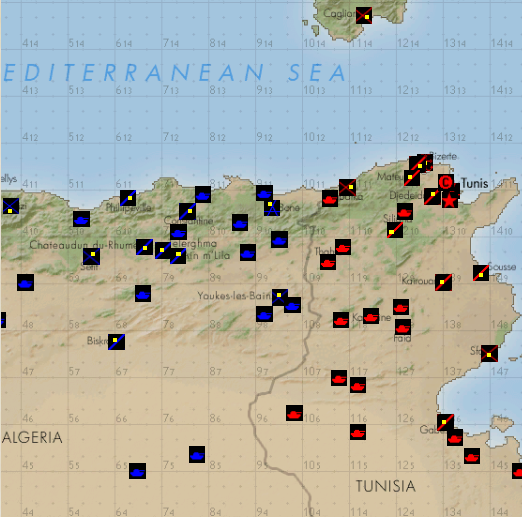 Â Â Â Â Â Â
      Country Percentages:
Â
Axis 50%
Allied 50%
Allies Knight
CM Rook
Â
Arena Settings:
Â
   --Tunis Map
   --Fuel Burn 1.0
   --Icons Short
   --.4 Ack
   --Fighter and Bomber Warning Range 48,000 (~8 nautical miles)
   --Tower Range 48,000 (~8 nautical miles, To Match Warning Range)
   --Visibility 17 Miles
   --Wind Speed CalmÂ
   --Radar Off
   --Enemy Collisions On
   --Friendly Collisions Off
   --Killshooter Off
   --Time: 12:00 Noon Game Clock
   --Formations: On
   --Bomber Calibration: Manual
Setup Rules:
   --4.5" M8 rockets disabled on P-38G.
   --210mm WGr21 rockets disabled on FW-190A5
   --The B-25 will have the strafer options disabled.
   --P-38G external ord limited to 500 lbs bombs only.
   --P-39D will have 20mm cannon loadout only.
   --P-39Q will have no wing guns.  Â
   -- ALL AIRCRAFT ARE TO BE LANDED AND THE PLAYERS TOWERED OUT BY FRAME END OR WILL BE CONSIDERED SHOT DOWN AND THE CREWS KIA.
Scoring:
Â
 Aircraft Pts
 ------------
 Bomber = 10 pts
 Fighter = 5 pts
 Landing Bonus = 5 pts
 IN FLIGHT AT FRAME END KIA = 25 pts
Â
 Ground Target Pts
 -----------------
 Gun = 1 pt
 Ammo Bunker = 3 pts
 Barracks = 3 pts
 Radar = 3 pts
 Vehicle Hangar = 25 pts
 Fighter Hangar = 25pts
 Bomber Hangar = 25 pts
 Town Building = 3 pts
 Ship in Port = 5 pts
 Truck in convoy = 5 pts
 Tug or Barge = 5 Pts
 Â
Â
Available Historic and Theater Specific Skins:
14FG by Oboe
14FG/37FS by Fencer
1FG/94FS by Oboe
82FG by Oboe
P-39D::
350FG/346FS by Fencer
P-39Q:
15FG/46FS by Rogerdee
P-40F:
Default= 79FG/87FS by Cactus
Spit MK V:
4FS/52FG by Greebo
52FG/5FS by Kev367th
Spit MK IX:
309FS by Rogerdee
52FG/4FS by Larry
Boston III:
47BG/84BS by Greebo
B-25C:
340BG/487BS by Fencer
B-26B:
344BG/495BS
Fighters Luftwaffe:
BF-109F:
3./JG27 by Krusty
BF-109G2:
8./JG27 by Fencer
8./JG27 by Rogerdee
BF-110C:
8./ZG26 by Krusty
FW-190A5
6./JG2 by Piterko
JU-87D-3:
6./StG2 by Raptor01
JU-88A-4:
2/LG1 by Greebo
- Details
- Written by: James Glazier
- Category: Mediterranean Theatre
- Hits: 19
 Â
 With the overthrow of Mussolini on the 24th of July and his replacement as head of government by Marshal Ugo Cavallero in place, secret talks were started with the Allies for an armistice for Italy. Hitler was ignorant of this, but was naturally suspicious. He started to send reinforcements into northern Italy to safeguard German communications.
Field -Marshal Albert Kesselring, the German supreme commander in the south reckoned that the Allied conquest of Sicily would soon be followed by a landing in Italy, just south of Naples. On September 3rd BAYTOWN was launched and the British Eighth Army made a landing on the toe of Italy, at Reggio di Calabria. This was a diversionary attack designed to draw German reinforcements down from the Salerno area which Kesselring had correctly suspected the main invasion would be.
B-25C
P47D-11
P38G
Spit V
Spit IX
P-40E
P-39Q
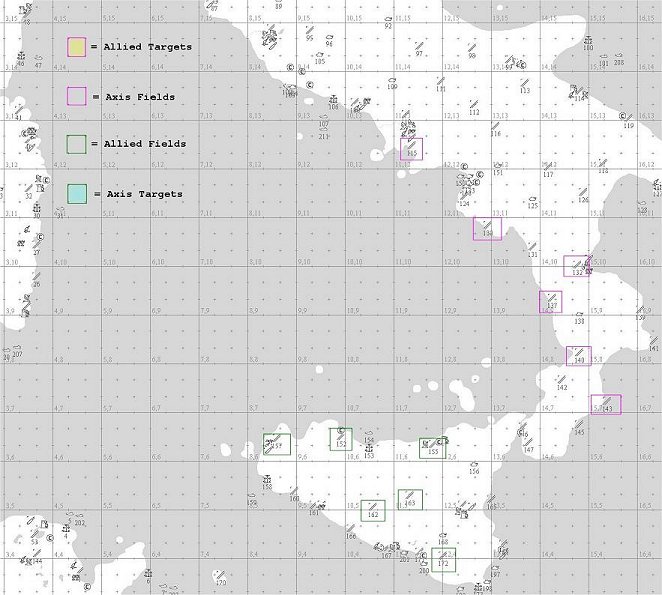
A157
A162
A163
A172 Â
109G2
109G6
190A5 (limited to 40)
C202
C205 (limited to 40)
Twin engine bombers 15 points
Heavy bomber 20 points
Hangers 20 points each
Escorting Destroyers 60 points each
Town buildings 1 point each
-Fighter and Bomber warning range 52,800 (10 miles)
-Tower range set to 52,800 (for display to match the above setting)
-Visibility full 17 miles
-Radar on (tower only)
-Enemy collisions on
-Friendly collisions off
-Killshooter off
-Time 1100 (11 AM) Game clock
-Bomber calibration manual
-Winds none
Â
- Details
- Written by: Darren F. Gideon
- Category: Mediterranean Theatre
- Hits: 16
Adventure in the
Dodecenes
Operation Accolade (1943)
PLAYBILITY NOTES
Several non-historical adaptations have been made
to this campaign to make it playable for 400+ players.Â
1) Obviously the both sides had more planes
involved in the battle than were historical available and involved in the
battle for
Dodecanese campaign in 1943.
2) British air assets were based out of
Cyprus and later
Kos.
British Carriers were not involved in the scaled campaign of just invading the
Dodecanese instead of the Dodecanese and
Crete.
British CVs have been added to the event to allow for flexibility and increase
the theater of operations.
3) We do not have the appropriate British Carrier dive bomber so the SBD will be subbing for it.Â
4) Historically the Italian air assets in the Dodecenes and Greek theater were SM.79s, Cant.Z1007s, CR.42, and M.200s. For playability sake the Italians will be given M.202s, M.205s, and Ju87s; all of which they operated at the time of their capitulation but in a different theater.
5) The theater of operations has been widen to the original goals of Accolade, which were Crete, the Greek Islands, and the Dodecenes islands.Â
6) The B26 and Mossie have been added to the British side. The British did not have bombers involved historically in this campaign except 3 days in October and 2 days in November. Beaufighters were used so the Mossie should be a decent replacement.Â
7) I have given the Germans 110G2 for balance purposes.Â
8) Historically P38s were involved in the campaign but only to cover the British withdrawal from the Dodecenes. So they will be available in frame 3
DESCRIPTION
With the defeat of Axis forces in
North Africa in spring 1943, Winston Churchill advocated
that the Allies should strike German forces in the Aegean next. He envisaged an
operation to capture the Dodecanese and Crete which would not only deprive the
Axis of excellent forward bases in the Mediterranean, but also apply pressure
on neutral
Turkey
to join the war. In addition, this would also provide a supply route through
the Dardanelles to
Russia as
an alternative to the current Arctic Convoys and route through
Iran in use. At
the Casablanca Conference, the initial go-ahead was given, and Churchill
ordered his commanders to lay out relevant plans on 27 January 1943.
The plans, codenamed "Operation Accolade,"
called for a direct attack on Rhodes and
Karpathos,
with three infantry divisions, an armored brigade, and relevant support units.
Landings at
Crete were dropped because it was
too well fortified and had a strong German garrison. The main problem faced by
the planners was the difficulty of countering the X Fliegerkorps of the
Luftwaffe because of a lack of air cover, since the allied aircraft were based
in
Cyprus and the
Middle East. Demands for aircraft, supplies, ships, and
troops for the upcoming invasion of
Sicily
further exacerbated operational planning for Accolade. The
United States was also skeptical about the
operation, which they regarded as aiming mostly at post-war political benefits
for
Britain, and an
unnecessary diversion from the main front in
Italy. Ultimately, the
U.S. refused to
support Operation Accolade and warned the British that they would have to go on
alone.
As an Italian surrender became increasingly
possible, in August 1943 the British started preparations to take quickly advantage
of a possible Italian-German split, in the form of a scaled-down
"Accolade". A force based on 8th Indian Division started being assembled,
and
America
assistance in the form of P-38 Lightning long-range fighter squadrons was
requested. As a result of the Quebec Conference however, and the American
refusal to assist the British plans and the forces and ships earmarked for
"Accolade" were diverted to other fronts, barely a week before the
surrender of Italy on 8 September.
On the announcement of the Armistice, the Italian
garrisons on most of the
Dodecanese
Islands either wanted to
change sides and fight with the Allies or just return to their homes. However,
in anticipation of the Italian surrender, German forces, based largely in
mainland
Greece,
already had plans in placed to counter this and rushed to block the British
from taking control of the islands as they launched operation Accolade.
PLANESET FOR THE FSO
BRITISH (Allied)
B-26B
Mosquito
MK VI
P-38G
(limited and only in Frame 3)
Spitfire V
Spitfire IX
Seafire II
SBD
ITALIAN (Allied)
C.202
C.205
Ju87D-3
GERMAN (Axis)
Bf 109G-2
Bf 109G-6
Bf 110G-2
Ju87D-3
Ju 88A-4
Â
COUNTRY PERCENTAGES
The sides will be divided into roughly 49% Allies
and 51% Axis, do to the Axis historically turning out slightly less than the
allies in events.
Â
SCORING
AIRCRAFT
05 pts - Single Engine AC with 1 crew
10 pts - Single or double engine AC with 2 crew
15 pts - Double Engine AC with 3+ crew
BASES
288 - Small Airfield
396 - Medium Airfield
572 - Large Airfield
219 - Vehicle Base
SHIPS
CV - 120 points
CA - 60 points
DD - 30 points
NOTE: When a base is attacked the attacker gets
the points for objects destroyed at the base while the defender gets the points
for all objects not destroyed at the base.Â
Â
ARENA SETTINGS
- Greece
- Fuel 1.00
-Â Icons --> Friendly and Enemy 3K at all altitudes
- .5 AckÂ
- Radar: none
- Fighter and Bomber warning range 26,000 (about 5
miles)Â
- Tower range set to 26,000 (for display only to
match the above setting)Â
- Clouds / visibilityÂ
  Frame 1, 11 miles
  Frame 2, 7 miles
  Frame 3, 8 miles
- Radar offÂ
- Friendly collisions offÂ
- Enemy collisions on
- Kill shooter offÂ
- Calm windsÂ
- Time: 11 AM
Â
Â
SPECIAL RULES
Â
NOTE: special rules sent out with the objectives
trump these special rules.
1. Nobody gets a second life.Â
2. Bomber formations are enabled for B26s and
JU88s.
4. Partial damage is awarded for CV damage. If the
a CV suffers 2000 lbs of damage  40 points are awarded. If a CV suffers
4000 lbs of damage another 40 points are awarded for a total of 80. If the CV
is sunk the full amount of 120 points is awarded (the last 40 points is added
to the previous 80).
Â
5. A minimum and maximum number will be assigned
to each aircraft type. The CiC of each side must deploy the designated minimum
per aircraft type and can not more than the maximum per aircraft type. Outside
of that the CiCs can deploy the aircraft types anyway the want (i.e. can have
squads fly 2 aircraft types and in split they wish as long as squads are assigned
same objective).Â
6. If both CiCs agree they may have the setup CM
end the frame early. This is usually done if one side wipes out the other side
(i.e. 60 versus 5).Â
7. Dead pilots may gun bombers. They may not man
the guns of airfields or ships.Â
8. Ships can maneuver by the their side during the
frame as long as they stay in their containment area. Ships must stay in
containment area defined in the objective orders. If they go outside of the
containment area a penalty will be assessed.Â
9. All targets must be attacked within the first
hour of the event. Both CiCs should include sending their battle plans to me so
that I have proof that they planned to attack their targets by T+60.Â
10. All attack targets assigned must be attacked
by a credible force. I define a credible force to be at the very least 2 x 4-6
squads (so 8-12 planes) or 1 7x10 squad. Obviously CiCs can deploy a larger
force per target as their plan dictates but no defending or attacking with just
1 x 4-6 squad.Â
11. All defense targets must be defended by a
credible force. I define a credible force to be at the very least I define a
credible force to be at the very least 2 x 4-6 squads (so 8-12 planes) or 1
7x10 squad.Obviously CiCs can deploy a larger force per target as their plan dictates
but no defending or attacking with just 1 x 4-6 squad.Â
12. Bombing calibration will be MA norm.
- Details
- Written by: Spikes
- Category: Mediterranean Theatre
- Hits: 19
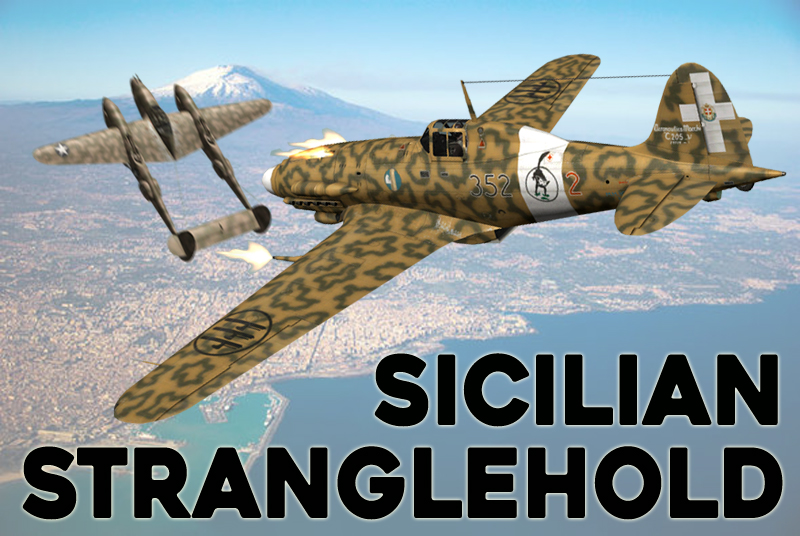
By the time Allied forces landed in Sicily on July 10th and 11th, 1943 the air war over the island itself had raged on for over 2 months. The battle for the skies over the Italian island began almost immediately after the destruction of Afrika Korps in Tunisia. The surrender of German and Italian forces on May 12th resulted in 130,000 Germans and 120,000 Italians captured along with German General Von Arnim and 25 other Axis generals.
The following month on June 11th, the fortress island of Pantelleria was captured and a new base of operations for Allied fighters and bombers was established outside of Malta. Now, the 19 Axis airfields in Sicily were under attack by a full assortment of Allied aircraft and the Luftwaffe and Regia Aeronautica were forced off the island. The Allies had won the sky and now were in position to land their forces on the island.
Notable squadrons during the battle for Sicily were the 99th Pursuit Squadron and the 332nd Fighter Group, America’s first all black fighter squadrons. The Tuskegee Airmen would be awarded their first Distinguished Unit Citations for their actions over Sicily from May to June. Jagdgeschwader 77, commanded by Johannes “Macki” Steinhoff was the main Luftwaffe fighter group taking on the Allied onslaught. Despite insurmountable odds, JG 77, IV./JG 3, and JG 53 still managed to put up a valiant defense.
The fight for the island of Sicily would last until August 17th when the last Axis units evacuated onto the Italian peninsula. The invasion of Italy would begin a few short weeks later on September 3rd. This FSO recreates the fight for Sicily after the launch of Operation Husky.
PLANE SET
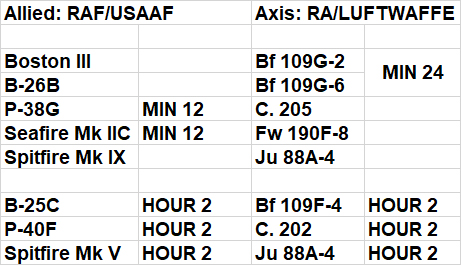
*SPECIAL RULES*
Fw 190F-8 - PB-1 Panzerblitz Rockets Disabled.
P-38G - 1000lb bombs Disabled.
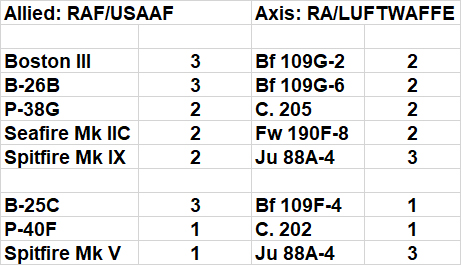
AIRCRAFT SCORING
OBJECT SCORING

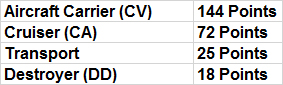
SHIP SCORING
Ace Pilot Kills = 20 Points
So for example if an Ace Pilot is shot down they are worth 20 points to the other side. Like wise, every victory an Ace Pilot lands they will be rewarded 20 points.
Frame 2 – (USAAF) – (P-38G) William “Dixie” Sloan - Lieutenant Colonel Sloan joined the Army Air Corps in 1942 and was one of the last flying Staff Sergeants before being commissioned as a 2nd Lieutenant. Sloan was sent to North Africa with the 96th FS, 82nd FG, where he would become the highest scoring P-38 ace in the MTO with 12 victories. Sloan was awarded the Air Force Cross for shooting down 2 enemy fighters and driving the other away on Jul 5th, 1943. Sloan would also go on to fly 50 missions in the Berlin Airlift. Dixie Sloan would pass away in Xenia, Ohio in 1999.
Frame 3 – (RAF) - (Spitfire Mk IX) Brian Kingcome - Wing Commander Kingcome joined the RAF in 1936 and fought in the Battle of France and Britain. In 1942 he took part in the mission to sink the Axis Cruisers attempting to escape through the English Channel to Germany. In 1943 Kingcome was sent to North Africa to lead 244 Wing. By the end of his stay with the wing, he had brought his total personal tally to 8 destroyed, three shared, five probable and 13 damaged enemy aircraft. Kingcome passed away in 1994 at 76.
Frame 2 – (Regia Aeronautica) – (C.205) Luigi Gorrini - Gorrini flew with the Italian Air Corps in the Battle of Britain, Libya and Tunisia. Gorrini’s first kill in 1941 over Greece was in a Fiat CR42 and then he progressed to the Macchi C.200, C.202, and C.205. Gorrini began flying the 205 in the defense of Rome and quickly became a master, shooting down P-38s, P-47s, B-17s and B-24s his kill count reaching 19 victories. Gorrini would fly for the Aeronautica Nazionale Repubblicana and later the postwar Italian Air Force, he would pass away in November of 2014.
Frame 3 – (Luftwaffe) – (Bf 109G-6 or G-2) Wolf-Udo Ettel - Ettel joined the Luftwaffe in November of 1939 and completed flight training in September 1941. In 1942 he was posted to JG 3 in Russia where he quickly rose in the ranks and victories. Reaching 120 victories by May of 1943, Ettel was shot down and escaped back to friendly lines earning the Knights Cross. Ettel was then transferred to III/JG 27 in Greece and later Italy where he would shoot down at least 4 aircraft in three days from July 14th - 16th. On July 17th, 1943, Ettel would be shot down by enemy ground fire. His total victories stood at 124 kills.
***PLEASE USE MAP INCLUDED IN OBJECTIVES***
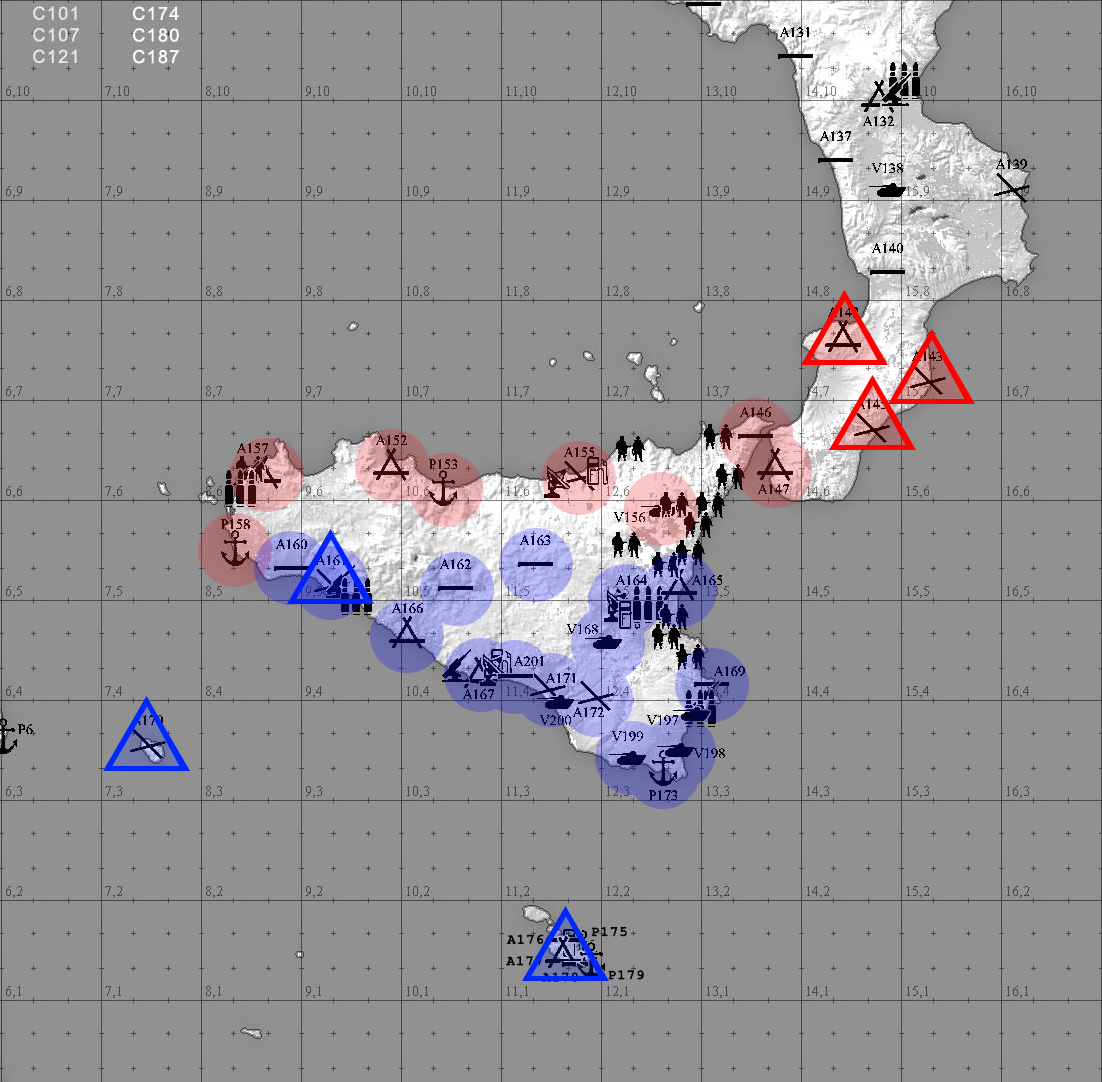
- Enemy Collisions - On
Designed by Nefarious
- Details
- Written by: David
- Category: Mediterranean Theatre
- Hits: 20
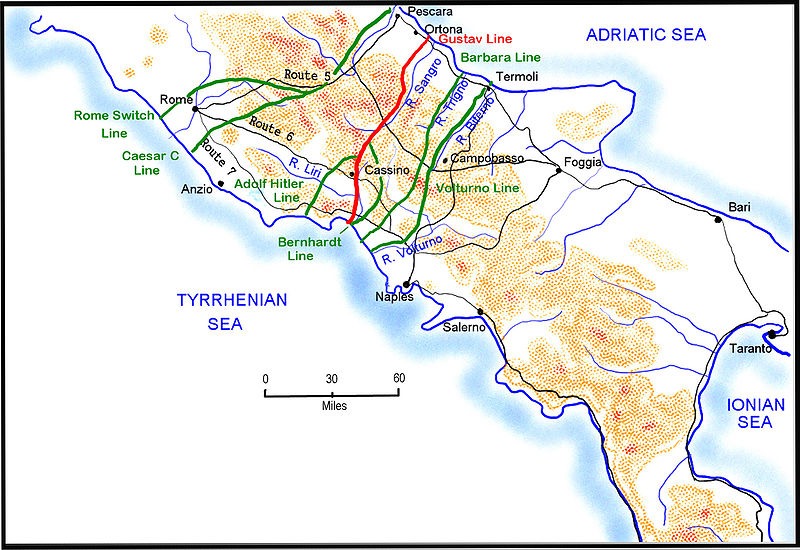 ?Breaking Gustav? 1944
After Operations Baytown, Slapstick, and Avalanche the Allies has a secure hold on southern Italy. Between the Allies and Rome stood 15 Divisions of the German army. They army had a fortified line of defenses from East coast to the West coast south of Rome with orders from Hitler to hold the Allies at bay. This was known as the Gustav Line.
After gaining air superiority, Allied air forces where tasked with breaking supply lines and weakening the Gustav line. Railroads, communication, and bridges where the primary targets of this effort. Over 1000 sorties per day hit targets in Northern Italy and gave close support to ground troops.
This FSO will attempt to recreate some of this action with playability concerns taken into account. As we have no targetable bridges, railroads Factories and bases will be used as targets.
Scoring:
-Single Eng. AC: 5 pts
-Dual Eng. AC: 10 pts
-Quad Eng. AC: 15pts
-Each side will be awarded a percentage based on destroyed/undestroyed items
Small AF - Total of 293 points.
Port - Total of 224 points.
Radar STRAT - Total of 413 points.
Fuel STRAT - Total of 370 points.
AAA STRAT - Total of 375 points.
Side Balance:
Allies: 50% - Knight
Axis: 50% - Bishop
Plane Set:
Allies:
P51-b(max of 24_No external ord)
P-47d11
P-38J
Spit MkVIII
Spit MkIX (max 32)
A20
B26
B24 (max of 18)
Axis:
Bf-109G2
Bf109G6
Fw190A5(max of 72)
Bf110G
C205 (Max of 24)
Ju-88
Arena Settings:
-Terrain: Italy_1
-Fuel: 1.0
-AutoAck: .5
-Fighter/Bomber/tower range: 48,000
-Icons: 3k (9000 in arena settings)
-Fog: 17miles
-Winds: Will vary per frame and be listed in objectives
-Radar: off
-Enemy Collisions: on
-Friendly collisions: off
-Killshooter: off
-Bombsite Calibration: Manual
-Time: Will vary per frame and be listed in Objectives.
- Formations on
Special Notes:
All aircraft, except those with a stated maximum, must have at least 24 used per frame.
P51B may not carry external Ordnance.
Any friendly base may be used for rearming/landing.
All Targets must be attacked in force by T+60.